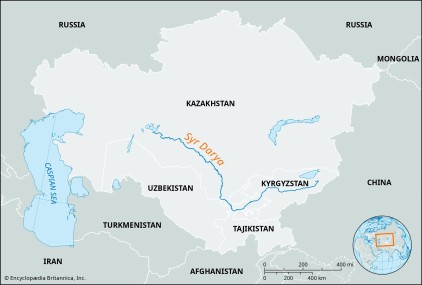
Central Asian countries are preparing a work plan to expand automated water-resource accounting in the Syr Darya basin. A working group made up of officials from participating countries is expected to be formed by the end of September.
The agreement was reached on August 7 in Turkistan, Kazakhstan, at the 94th meeting of the Interstate Commission for Water Coordination, Uzbekistan's Ministry of Water Resources reported.
The meeting also reviewed water-intake limits and reservoir operating regimes for the Amu Darya and Syr Darya basins for the 2026 growing season.
According to the data presented, nearly 3 billion cubic meters (BCM) of water have flowed into the Shardara Reservoir since April 1 — above both last year's figure and the long-term average. The situation in the Syr Darya basin is currently assessed as stable.
The parties noted the need for efficient water use, compliance with the established limits, and improved data-sharing on water resources between the countries.
"One of the key issues was automating water accounting in the Syr Darya basin. It was agreed to develop a draft work plan on this front and form a working group of representatives from the participating countries by the end of September," the ministry said in its statement.
The same day, a meeting of the Uzbek-Kazakh Joint Working Commission on water relations was also held.
It reviewed a project to automate 10 hydrological gauging stations located on the territory of the two countries. The parties agreed to speed up efforts to attract grant funding to complete the project and to explore extending automated water accounting to other facilities in the Syr Darya basin further down the line.
In May, Tajikistan, Uzbekistan and Kazakhstan agreed on the operating regime of the Bahri Tojik Reservoir for June–August 2026. In December, the Interstate Commission for Water Coordination for Central Asia agreed on water-intake limits and reservoir operating procedures for the non-growing season of 2025–2026. Under that agreement, Uzbekistan will draw 22 BCM of water from the Amu Darya and 3.347 BCM from the Syr Darya in 2026.
Stay up to date with all the latest news: