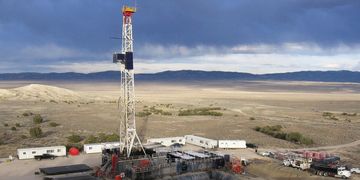
The Cabinet of Ministers has drafted a resolution aimed at streamlining the procedure for approving subsoil-use projects submitted by private business entities.
The document proposes adopting a "Regulation on the Procedure for Approving Project Documentation for Subsoil Use."
The new procedure covers the approval of geological survey and field-development projects, as well as the review and expert appraisal of feasibility studies.
Under the draft, this work would be carried out by the state institution "Subsoil Use Center," operating under the Ministry of Mining Industry and Geology, while the Inspectorate for Control over Mining Industry and Geology would issue opinions on designated matters.
Applications for approval or expert review of geological survey projects, field-development projects, and feasibility studies are to be submitted through the Single Portal of Interactive Government Services (SPIGS).
Services provided by the Center would be carried out on a contractual basis, with full advance payment required. In addition, a separate filing fee equal to 50 percent of the base calculation value (BRV) is envisaged.
Fees would vary by mineral type and project category. Approving a geological survey project for non-metallic minerals would cost 0.06 percent of the project's investment value, with payment set at no less than 20 times and no more than 50 times the BRV. The same 0.06 percent rate is proposed for survey projects involving major minerals and hydrocarbons, ranging from 70 to 200 times the BRV.
For field-development projects and feasibility-study reviews involving non-metallic minerals, a 0.03 percent fee is proposed, ranging from 70 to 150 times the BRV; for major minerals and hydrocarbons, the same rate would apply but range from 100 to 1,000 times the BRV. Where a development project and feasibility study are submitted together, fees would be capped at 150 times the BRV for non-metallic minerals and 1,000 times for major minerals and hydrocarbons.
One notable innovation is the introduction of a "silence means consent" principle in parts of the approval process. For geological survey projects, the Inspectorate must review documents within 12 working days and upload its findings to SPIGS; if no decision or objection is issued within that window, the project is deemed approved. The same rule would apply to hydrocarbon-discovery assessment plans and field-development project reviews.
The Center would have 25 working days to complete expert review of complete development-project and feasibility-study packages, extendable by up to 10 working days for complex cases with prior notice to the applicant. Initial review of geological survey projects is set at 17 working days, similarly extendable by up to 10 days.
Applicants would have 20 working days to correct deficiencies in geological survey documentation, and 90 working days for field-development projects; resubmitted documents would then be reviewed within 15 working days. As a general rule, reviewers could not raise new objections not flagged in their original opinion.
The draft also gives applicants added means to contest decisions: they may withdraw or amend an application, submit written justification against amendments, or request a hearing — held in person at the Center or via videoconference, in Uzbek or Russian — to present their case.
All project documentation must be submitted to the Center in Uzbek; documents prepared in other languages must include an official Uzbek translation.
Looking ahead, authorities plan to integrate SPIGS with the "Geomonitoring" information system, after which applications submitted via SPIGS would be routed to Geomonitoring in real time, with final results delivered back to applicants through the portal.
Stay up to date with all the latest news: