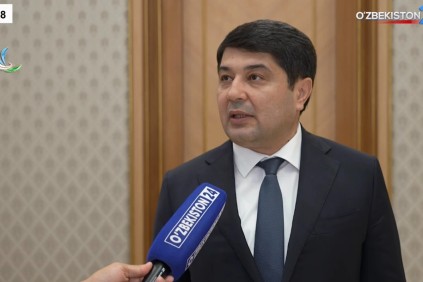
Ministry of Economy and Finance will revise the 2026-2027 spending budgets for Uzatom, the state nuclear energy agency, and the Directorate for the Construction of the Nuclear Power Plant. Deputy Minister of Economy and Finance for Oil and Gas Khurshid Mustafayev announced the move Wednesday September 2, following a presentation to President Shavkat Mirziyoyev on the progress of the nuclear plant's construction.
According to Mustafayev, the president instructed officials to ensure timely financing for the project and to prevent any delays in construction work.
"The head of state gave clear instructions that all work must be completed on schedule, without delays, and, where possible, ahead of schedule," the deputy minister said in an interview with the Uzbekistan 24 television channel.
He added that the Ministry of Economy and Finance must guarantee funding for the project within the framework of annually approved budgets.
Officials have also been instructed to ensure uninterrupted financing for Uzatom, which operates under the Cabinet of Ministers, and for the plant's construction directorate, as well as to expand their staffing levels.
"Given the tasks at hand, the spending budgets of the agency and the directorate for 2026-2027 will be revised, and matters related to additional staffing and timely payments will be resolved through established procedures," Mustafayev said.
Under the state budget laws, Uzatom was allocated 42.7 billion soms in 2025, all of it classified as operating expenses. For 2026, the agency's budget has been increased to 46.4 billion soms — a rise of roughly 3.7 billion soms, or 8.7 percent — again allocated entirely to operating costs.
On August 17, Mirziyoyev said Uzbekistan was engaged in "extensive preparation" for a second nuclear power plant, though the proposed site, capacity, and construction timeline have not yet been disclosed.
The nuclear plant currently under construction in the Farish district of Jizzakh province will feature four power units: two VVER-1000 reactors with a capacity of 1 gigawatt each, and two small modular RITM-200N reactors with a capacity of 55 megawatts each. The plant's total capacity will reach 2,110 megawatts, with expected annual output of up to 17 billion kilowatt-hours.
The first small modular reactor is scheduled for technical launch in October-November 2029, followed by the second unit six months later. The first large power unit is expected to come online in 2033, with the project fully completed by 2034-2035.
The project's base cost has previously been estimated at up to $9.5 billion, with the bulk of financing expected to come from loans, including a preferential export credit from Russia.
Stay up to date with all the latest news: