At the peak of construction, Uzbekistan's first integrated nuclear plant project in the Jizzakh province is expected to employ more than 10,000 workers and specialists on-site, with local personnel making up 65 to 70 percent of that workforce. The figures were disclosed by the Atomic Energy Agency, Uzatom, following the presentation made to President Shavkat Mirziyoyev.
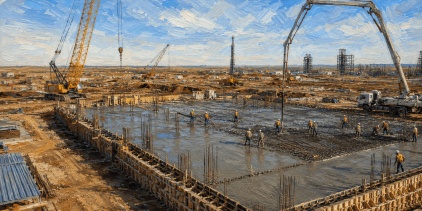
The project — the country's first integrated nuclear power plant — has now entered its active construction phase, with work currently concentrated on the foundation of the first power unit. Since June 4, crews have poured 916 cubic meters of concrete at the site, and both the construction-assembly base and foundation work are proceeding on schedule, according to Uzatom.
"This is no longer a demonstration phase. The excavation pit is closed, concrete is being poured, and the base is taking shape. Our job now is to keep up the pace and prevent any gap between the earthworks, concrete work and design work," said Abdijamil Kalmuratov, director of the plant's construction directorate.
He described the 916 cubic meters poured so far not as a symbolic gesture but as the start of the first unit's load-bearing structure. The next phase, he said, should focus on accelerating the design of plant-wide facilities and manufacturing equipment with long production cycles.
"Most IAEA recommendations have been performed"
Uzatom also reported that an environmental impact assessment has been completed and approved, and that the necessary permits and licenses have been secured for siting and constructing the plant's small modular reactor units.
From June 22 to 26, Uzbekistan hosted a follow-up International Atomic Energy Agency (IAEA) Integrated Nuclear Infrastructure Review (INIR) Phase 2 mission, involving 41 officials and experts from 16 ministries and agencies. According to Uzatom, the mission concluded that most of the recommendations issued to Uzbekistan in 2021 have now been implemented. An official report is expected to be published on the IAEA's website once the review process concludes.
Rozaliya Kamaeva, an adviser and chief of Uzatom's consolidated information, analysis and strategic planning department, described the mission as a "global stress test of the entire state apparatus."
"A nuclear project isn't measured only in cubic meters of concrete — first and foremost, it's a test of a country's technological maturity. It's a project built on trust, and a test of the ability to operate under conditions of absolute nuclear safety," she said.
The IAEA mission had previously concluded that Uzbekistan has made significant progress in preparing infrastructure for nuclear power, though the country still needs to complete feasibility studies and strengthen its nuclear regulatory body.
A 200-hectare industrial zone and localization above 30 percent
Expanding the role of domestic manufacturers will be a separate focus of the project. Uzatom estimates that current localization potential stands at up to 21 percent of the project's total cost, with more than 30 Uzbek enterprises already capable of supplying cable, rolled metal products, reinforced concrete structures and waterproofing materials.
To push localization above 30 percent, officials are proposing the creation of a specialized 200-hectare industrial zone in the Farish district, roughly 25 kilometers from the plant. The zone would host production and assembly operations across 15 sectors and create up to 2,000 jobs.
"The nuclear plant should deliver more than just kilowatt-hours — it should also build an industrial school. The Farish industrial zone is the tool that turns localization from a slogan into an actual production chain," Kalmuratov said.
For external infrastructure, the president has set a separate target of 60 to 70 percent local content in goods and services. According to the directorate's chief, the nuclear island itself will remain under the general contractor's responsibility, while the surrounding site, construction base, materials and infrastructure should draw as heavily as possible on Uzbek companies wherever technically feasible.
Power lines, roads and a town for 33,000 people
As part of the plant's external infrastructure, plans call for building 388 kilometers of power lines, a substation, 21 kilometers of drinking-water pipelines, 120 kilometers of technical water-supply lines, 39.5 kilometers of roads and 11 kilometers of railway.
The plant site itself will span 525 hectares. According to Uzatom, an adjoining "nuclear town" will cover 100 hectares and be designed to house 33,000 residents, with around 10,000 apartments planned overall — 3,000 of them to be built in the first stage. The town will also include research institutes, schools, kindergartens, and medical, sports and cultural facilities. Uzatom describes it as a future high-tech scientific and industrial cluster and eco-town.
"The nuclear town shouldn't be thought of as a temporary work camp. It's a residential, social and educational environment that will anchor skilled workers in the province and transform the economy of the Farish district. A town keeps people — not through shift work, but through families, schools, healthcare and everyday life," Kalmuratov said.
More than 10,000 workers at peak construction
At the height of construction, the site is expected to employ more than 10,000 workers and specialists, with local personnel accounting for 65 to 70 percent of that total.
Since 2023, 216 students have graduated from the Tashkent branch of Russia's National Research Nuclear University MEPhI. Of them, 83 are continuing their studies at the graduate and postgraduate level in China, Hungary, France, Italy and South Korea, while another 100 specialists are training at four universities in Uzbekistan.
"You don't start preparing to operate a plant the year it opens — that preparation is happening now. The 216 graduates from the MEPhI branch are the first foundation of a future industry. But diplomas alone aren't enough — we need operators, engineers, radiation-safety specialists and a strong state management apparatus," Kamaeva said.
Independent oversight of construction
To strengthen technical oversight, officials are proposing the creation of a joint venture with a leading international engineering firm. The venture would independently assess design documentation, key equipment components and construction quality, adding an additional layer of oversight beyond the construction directorate itself. The venture's participants and timeline have yet to be finalized.
"The general contractor builds the plant, but full responsibility for safety — to its own people and to the international community — rests solely with the customer," Kamaeva said, adding that the joint venture is also meant to transfer engineering and management expertise to Uzbek specialists. The project also envisions adapting and adopting roughly 1,000 industry standards.
What's planned through the end of the year and into 2027
By the end of 2026, authorities aim to finalize design documentation, begin construction of external power networks, deepen localization, and accelerate training for both the customer's staff and future plant employees.
In 2027, work is expected to begin on licensing documentation for the plant's large VVER reactor units, along with design work on plant-wide buildings and orders for equipment with long manufacturing lead times.
On August 17, President Mirziyoyev said "extensive preparatory work" was underway on a second nuclear power plant for Uzbekistan, though the proposed site, capacity and timeline for that project have not yet been disclosed.
The integrated nuclear plant under construction in the Farish district of the Jizzakh province will consist of four power units: two 1-gigawatt VVER-1000 reactors and two 55-megawatt RITM-200N small modular reactors. The plant's total capacity will reach 2,110 megawatts, with expected annual output of up to 17 billion kilowatt-hours. Uzatom notes that the site has room for two additional large power units in the future.
Technical startup of the first small modular reactor is planned for October or November 2029, followed by the second unit six months later. The first large power unit is expected to come online in 2033, with the project fully completed by 2034-2035.
The project's baseline cost has previously been estimated at no more than $9.5 billion, with the bulk of financing expected to come from loans, including a concessional export credit from Russia.
Stay up to date with all the latest news: