Uzbekistan is proposing, for the first time, to define the legal status of community officers within the Interior Ministry system through a dedicated law — spelling out their duties, rights, obligations, professional guarantees and social protections.
The Status of Community Officers of Police Bodies Bill submitted by the president as a legislative initiative, was passed in its first reading by the Legislative Chamber on August 25. The bill comprises eight chapters and 37 articles.
MPs noted when presenting the bill that officers' work is currently governed by scattered provisions spread across various pieces of legislation, even as their range of responsibilities has expanded considerably. According to figures cited during the presentation, a single community officer handles more than 50 complaints and administrative cases each month on average, while also conducting preventive work with more than 30 individuals. Officers are additionally involved in resolving family conflicts, working with youth and minors, women and at-risk individuals, and countering cybercrime and other emerging threats.
What changes for community officers
The bill defines a community officer as an official who conducts pre-investigation inquiries and carries out community work within an assigned territory. It sets out nine core duties and six supporting duties for officers, including receiving and promptly handling complaints, placing individuals under preventive monitoring or administrative supervision, carrying out preventive measures, detecting and stopping offenses, managing administrative cases, and issuing protective orders for victims of harassment and violence, along with follow-up monitoring.
The bill also grants officers 22 specific rights. Among them: independently choosing which preventive measures to apply, issuing mandatory preventive directives, submitting formal recommendations and demanding their implementation, developing methodologies for preventive work, and preparing necessary documentation within their authority.
Separately, the bill lays out 15 obligations for officers, including adherence to professional conduct and workplace discipline, responding immediately to the scene of an offense, halting it, and providing first aid or other assistance to victims when necessary.
Shielding officers from outside interference
One stated goal of the bill is to limit interference in officers' professional work. It would explicitly prohibit assigning officers tasks unrelated to their official duties, interfering in their work, or burdening them with unwarranted additional assignments.
Government bodies would be required to respond in writing to an officer's request within 10 days, and to a formal recommendation within one month. Officers would also be granted free access to government information systems. The bill further establishes that an officer's honor, dignity and professional reputation are protected by the state.
More than 50% of residents could trigger a no-confidence review
One of the bill's most notable innovations is a mechanism allowing residents to formally express no confidence in an officer. If more than half the residents in a given service area express distrust of their officer, that officer would be referred for recertification, triggering a review of whether they remain fit for the role.
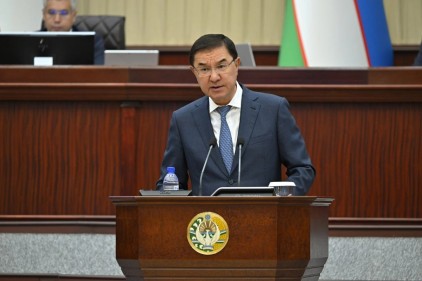
During debate, MPs pressed officials on how public trust would actually be measured. A representative of the Interior Ministry said the government would develop a separate procedure for this purpose. "We built in this provision so that residents have a voice. First and foremost, it should be the public that judges whether an officer is doing their job," the official said.
According to the official, voting is planned to take place electronically through a system called "Mening Inspektorim" ("My Officer"), where residents of a given area would be registered. "If more than 50 percent of registered residents express no confidence, measures could follow — up to and including removal of the officer from their post," the Interior Ministry representative said, adding that the exact mechanism would be defined by a Cabinet of Ministers resolution. Later in the session, the parliamentary speaker reiterated that the process would be electronic, with details to be worked out by the government.
Officers to take on cases currently handled by courts and other bodies
The bill also proposes expanding officers' authority to handle administrative offense cases. It would shift five categories of cases currently under court jurisdiction, nine currently handled by heads of internal affairs bodies, and four road-safety violations into officers' purview. Officers would also gain the authority to issue administrative warnings for 18 types of offenses. Bill drafters argue this would allow for a faster response to violations at the local level.
Local governments to provide officers with offices and housing
The bill strengthens social guarantees for officers as well. It would require local government bodies (hokimiyats) to provide officers with office space and housing. It also introduces additional pension guarantees: officers with more than 20 years of service would be entitled to a pension equal to 100 percent of their salary, along with extra bonuses for long service in the role.
During the debate, several MPs raised concerns about officers' working conditions. One deputy said that during visits to the regions, he had encountered cases where officers did not even have their own office. "There are places where an officer doesn't even have a workspace — they end up sitting in a hallway or somewhere else," the deputy said, calling for the requirement to provide office space to be made stricter and less ambiguous. Another suggestion raised was providing transport for officers in remote rural areas, since a lack of vehicles can delay their ability to respond quickly to crime scenes or incidents.
Neighborhood, school and university officers to be unified under one status
Another detail emerged during the Interior Ministry's responses: prevention officers currently working in neighborhoods, schools, universities and other areas would be unified under the single title of "community officer." Reporting requirements would still vary by workplace — a neighborhood officer would report to neighborhood residents, a school officer to school staff, and a university officer to the relevant institution.
How performance will be assessed
The bill also proposes evaluating officers' performance quarterly, semi-annually and annually. Metrics would include the level of public trust, the number of crimes committed by individuals in at-risk groups, and repeat administrative offenses. Each officer would also be required to brief residents of their assigned area on the local security situation once per quarter.
Following the debate, MPs approved the bill in principle in its first reading. Ahead of the second reading, the relevant committee is expected to revise the document to incorporate feedback and proposals raised by MPs.
Stay up to date with all the latest news: