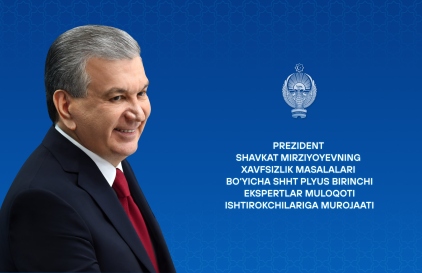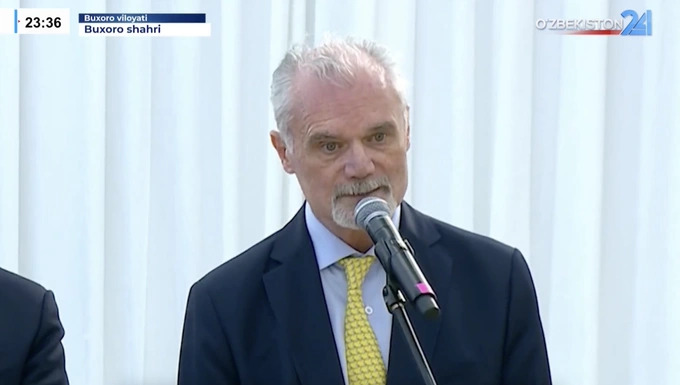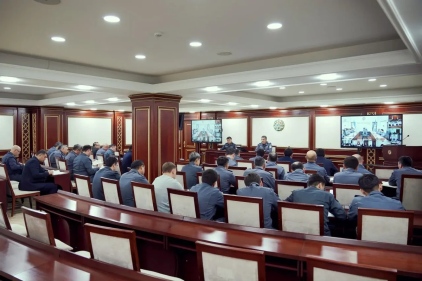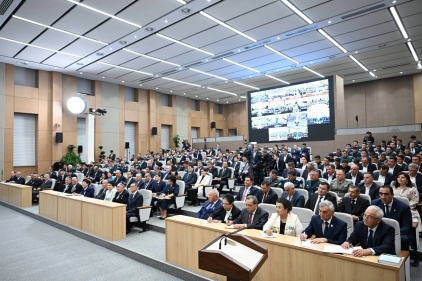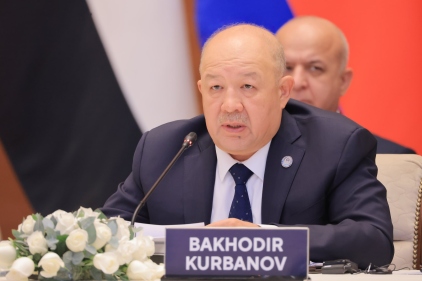
Achievements of the digital age must not become tools of terrorism, and states must work together to ensure they are used solely for peace, security and sustainable development, the chairman of Uzbekistan’s State Security Service, Colonel General Bakhodir Kurbanov, said at the first meeting of the SCO Plus expert dialogue on security in Samarkand tosay, Nov. 6.
“The Republic of Uzbekistan is committed to trusting and constructive engagement with international organizations and other states, in line with international law and humanist values, which we regard as the fundamental principle and basis of all our decisions and actions,” he said.
Following the meeting’s theme, “Security in the era of digital transformation: Combating terrorism and extremism amid the development of new technologies,” the head of the service outlined Uzbekistan’s initiatives in this area.
He said more than 49,000 extremist and terrorist internet resources were identified in Uzbekistan in 2026, 14% more than the roughly 43,000 in 2025. “This trend clearly shows the growing use of the global network to spread radical narratives,” Kurbanov said.
He said mechanisms for interagency and international cooperation had been improved under the 2021-2026 National Strategy for Countering Extremism and Terrorism. In the 2026 Global Terrorism Index, Uzbekistan ranked 96th (low impact of terrorism).
“Radicalization is a complex social process”
On online radicalization, especially among young people, Kurbanov stressed that “radicalization does not happen in an instant. It is a complex social process.”
“It cannot be prevented solely by blocking and removing unlawful content. A key part of the package of measures must be raising the population’s legal, spiritual and digital literacy, to build critical thinking and immunity to ideas of intolerance,” he said.
Shielding minors from destructive information is an important task, he said. Targeted work with young people and socially vulnerable groups is especially important.
He proposed that a special mechanism be set up under the Shanghai Cooperation Organisation (SCO) to share best practices in preventing online radicalization. “Such a mechanism could systematize effective national approaches, enable the exchange of experience in digital prevention work with young people and vulnerable groups, and develop cooperation among states, academia, civil society and technology companies,” he said.
He also proposed developing digital education programs to build media literacy and young people’s resilience to destructive influence. Such platforms should be adapted to the languages and cultures of states and peoples, he added.
Closer work with digital platforms
Another proposal was to expand cooperation between competent authorities and the administrations of international digital platforms.
Major technology companies, including those specializing in artificial intelligence, have significant capacity to detect terrorist and extremist content, stop its spread and identify coordinated networks of unlawful activity, Kurbanov said. But national laws differ, there are no uniform procedures for submitting requests, and responses are not fast enough, he said.
Uzbekistan has steadily developed international public-private partnership in this area, he said.
In August, an event on cooperation between state bodies and the private sector in countering the use of new technologies for terrorist purposes was held in Tashkent, with support from the UN Office of Counter-Terrorism, Interpol and the Office of the UN High Commissioner for Human Rights. Work is under way to build ties with reputable centers in other countries to address the digital and ideological roots of radicalism and strengthen tolerance.
He proposed that, with UN support, national authorities and leading digital platforms set up joint activities to monitor, block and remove terrorist content online and obtain evidence of unlawful acts.
Preventing the use of AI for terrorism
Another area of cooperation is preventing the use of artificial intelligence for terrorist purposes.
“Generative technologies significantly expand the capabilities of terrorist groups, allowing them to automate radical propaganda and information-psychological operations. Risks that seemed unthinkable until recently have become real, including the use of AI for cyberattacks and its combination with drones and other autonomous technologies to carry out acts of terror,” Kurbanov said.
AI is also a powerful tool for countering such threats, he said. It can help detect coordinated information campaigns, identify signs of information manipulation and make analytical units more effective. In February, the UN Office of Counter-Terrorism published guidance on the responsible use of AI to prevent violent extremism.
“Uzbekistan supports the view that the use of neural networks in the interests of security must come with clear legal and ethical safeguards. In this regard, we propose stronger cooperation against cyberterrorism. We consider it advisable to create an international platform for technological cooperation that would provide for the exchange of proven tools for detecting synthetic content, information on new threats, methods for testing defense systems and training programs for security officers,” Kurbanov said.