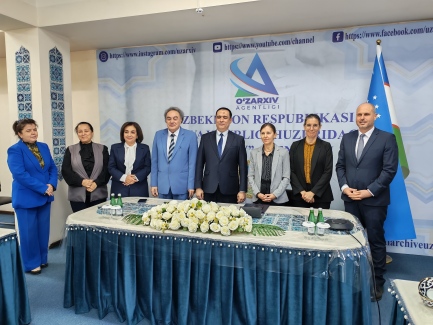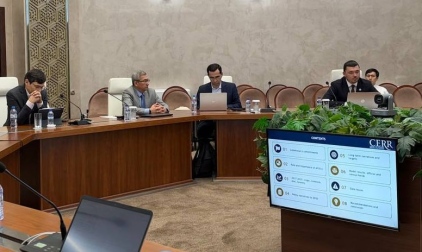
The Center for Economic Research and Reforms has conducted a study on decarbonizing Uzbekistan’s agriculture, the center’s press service said. The findings were presented on Oct. 19-20 at an international seminar held at the Ministry of Economy and Finance.
The center analyzed how agriculture, forestry and land use could be decarbonized by 2070. By its estimates, agriculture accounts for 17.5% of Uzbekistan’s total greenhouse gas emissions. Nearly two-thirds of the sector’s emissions are methane, mainly from livestock.
“The study found that between 2017 and 2025, grain yields rose 48% and raw cotton yields rose 71%. Water withdrawals fell 22%, and the area using water-saving technologies has reached 2.6 million hectares,” the center said, summarizing some of the findings.
The presentation stressed the need to use natural resources more efficiently. The study found that 37% of irrigation water is lost in canals and that half of irrigated land is affected by salinization.
The center’s experts have drawn up proposals to reduce the scale of these problems by 2070. The study recommends a series of measures to improve water resource management, cut food losses and make better use of agricultural land.
For reference, Uzbekistan’s total land area is 44.9 million hectares, of which 26.2 million hectares is used for agriculture. Of the remainder, 11 million hectares is forest and 4.2 million hectares is protected natural areas.
Reserve land accounts for 1.3 million hectares and the water fund for 1 million hectares. Land used for industry, transport, communications and defense totals 798,800 hectares, and land in populated areas 221,500 hectares. Land of historical and cultural significance covers 32,300 hectares.
Stay up to date with all the latest news: