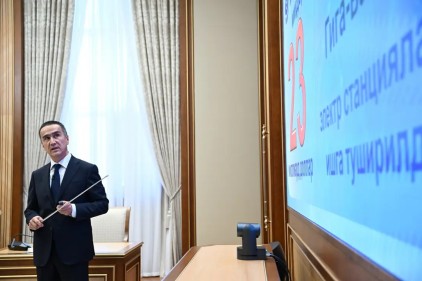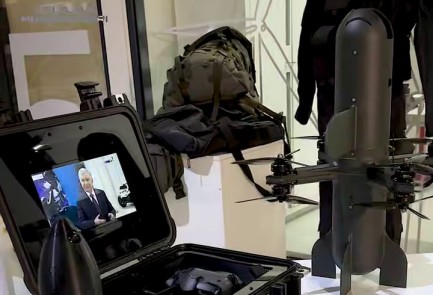
A team of young Uzbek engineers has unveiled an interceptor drone, dubbed "Shunkor-88," designed to shoot down hostile unmanned aerial vehicles, the Ministry of Education's press service announced. The system, presented by lead developer Ismail Bilolkhanov and his team at the national "Engineers of the Future" competition, is being pitched as a homegrown, cost-effective answer to the growing threat of drone attacks.
According to the ministry, Shunkor-88 can reach speeds of up to 450 km/h and engage targets at a range of 8 to 10 kilometers. Officials put the manufacturing cost of a single unit between $20,000 and $50,000 — a figure they frame as a bargain next to conventional anti-aircraft missiles, which typically run $2 million to $5 million apiece.
That comparison is technically accurate, but it's also the easiest one to win. Missiles designed to intercept aircraft and ballistic threats are a different category of weapon entirely, built for a different job at a different cost structure. The more relevant yardstick — and the one the ministry's announcement doesn't mention — is the fast-growing global market of drone-on-drone interceptors, an area where Ukraine, out of wartime necessity, has become the undisputed cost leader.
How Shunkor-88 stacks up
Ukraine's Skyfall P1-SUN, one of the cheapest interceptors in active service, is built on a lightweight 3D-printed airframe and costs about $1,000 per unit for Ukrainian forces, using computer vision and thermal imaging to track targets. Wild Hornets' Sting, another mass-produced Ukrainian interceptor, carries a unit cost of roughly $2,100. MaXon Systems' newer autonomous Shahed-hunting interceptor costs approximately $3,500, reaches speeds up to 300 km/h, and operates over a 30-kilometer radius. Even the pricier end of that market — the new fixed-wing interceptors entering service with the Ukrainian Air Force — cost around $5,000 per unit, according to Ukrainian military expert Taras Chmut.
Put plainly: at $20,000 to $50,000 per unit, Shunkor-88 costs somewhere between four and fifty times more than comparable Ukrainian interceptors that are already being mass-produced and combat-tested.
The gap is hard to explain away on performance grounds alone. Shunkor-88's 450 km/h top speed is fast, but it's not unmatched — some Ukrainian interceptors already fly at speeds between 195 and 280 miles per hour, or roughly 315 to 450 km/h, depending on the model. And on range, Shunkor-88 actually falls short of some cheaper rivals: Ukraine's Octopus interceptor, built for night operations and jamming-resistant flight, has a combat radius of roughly 30 kilometers — three to four times Shunkor-88's stated 8-to-10 km engagement range.
Scale may be the real story
One honest explanation is production volume. Ukraine's rock-bottom prices are the product of wartime mass manufacturing: Wild Hornets reportedly turns out 10,000 Sting units a month, while Skyfall has said it could scale to manufacture up to 50,000 interceptor drones a month. A hand-built competition prototype from a university engineering team is never going to hit that kind of per-unit cost — economies of scale matter enormously in drone manufacturing, and it would be unfair to expect a first-generation design to match prices set by companies years into wartime production cycles.
But that's precisely the information the ministry's announcement leaves out. Is the $20,000–$50,000 figure a projected mass-production cost, or the cost of building a single hand-assembled prototype for a competition? Are the components domestically sourced, or does the price reflect imported parts that a scaled-up production line could bring down significantly? And given that comparably fast, farther-reaching interceptors already exist commercially for a fraction of the price, what specifically justifies Shunkor-88's cost — beyond simply being new?
None of this diminishes the achievement of young engineers building a working interceptor drone from scratch. But if Shunkor-88 is meant to be presented as a serious, cost-effective alternative for national airspace defense — rather than a promising student project — a clearer breakdown of costs, production plans, and how it compares to battle-tested systems already on the market would make that case far more convincing than a comparison to multimillion-dollar missiles.
Stay up to date with all the latest news: