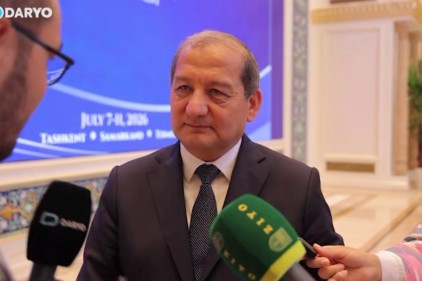
Uzbekistan is studying the possibility of creating conditions for the religious education of children and teenagers under 18, chief of the Department for Religious and Educational Affairs at the Presidential Administration Muzaffar Kamilov told Ziyo in an interview.
The publication's journalist noted that at present it is not possible to receive religious education in Uzbekistan before the age of 18, and that studying at a madrasa requires having first finished school. He asked whether any changes were planned in this area.
"Education today can genuinely solve a great deal. But this is a matter of the conditions under which that education is obtained. No one is standing in the way of education. For anyone who wants religious education, every format permitted by law is available to them," Kamilov said.
According to him, cases that were "suspended by law for certain reasons" are now under review.
"Why they were suspended, why it wasn't possible before, and why we might now be in a position to allow it — in other words, whether there's a genuine need for that. We're studying this. It needs to be understood correctly. There are certain objective and subjective circumstances behind it. We're not turning a blind eye to this. But steps toward improvement are gradually being taken," he said.
Kamilov stressed that society, families, and citizens themselves need to be ready for such changes. He recalled two periods in Uzbekistan's recent history when, in his words, religious freedoms were granted abruptly: in the late 1980s through the first half of the 1990s, and after 2016.
"In both cases, freedom was granted all at once. Just imagine the chaos and abuses that followed — we need to view this the right way," he said.
The Presidential Administration representative noted that Uzbekistan sits in a "serious region," which means the state has to act carefully.
"This isn't an obstacle to religion, nor is it a stance against religion. For instance, if a flag needs to be raised, if an idea needs to be put forward, it has to be done thoughtfully. Because we face certain risks, and we're all well aware that there are forces out there simply waiting for disorder or chaos on our part. There's a lot I can't say," Kamilov stated.
He said new opportunities in the religious sphere would open up gradually, in keeping with the secular nature of the state.
"Everything will open up step by step, gradually, with society being prepared for it, based on society's needs, and within the framework of the constitutional provision that Uzbekistan is a secular state. New stages and new opportunities ensuring freedom of religious belief will open up on the basis of our secular laws. Everything will be done within the bounds of the law," he said.
Kamilov emphasized that any actions taken outside the law "have no future." "That's why we're currently improving our legislation, studying the situation, analyzing it — research institutions are at work, extensive analysis is being carried out," he noted.
He also said that both the secular and the religious approach need to be kept in proper measure. "You can't call some kind of foolishness 'secularism.' That's just foolishness," he said.
Kamilov cited the issue of drug addiction among young people as an example, noting that freedom shouldn't be understood as permissiveness. "If we leave things under the banner of 'freedom, do whatever you want,' that's not a principle of secularism. Forgive me, but that's a tragedy," he stated.
Speaking about religiosity, he also warned against extremes. "We have terms — ifrat and tafrit — veering into one extreme or the other. No. Only if we properly establish wasatiyyah [the 'golden mean'], the middle path, will we avoid falling into error. Because this sense of moderation hasn't yet been clearly defined for us, everyone has started to interpret it their own way, and that's why our problems haven't found solutions yet. But if the middle path, the path of moderation, is properly shown within the framework of the law, there will be no falling into error — neither in religious practice nor in matters of faith. All sorts of things have happened whenever even a little freedom was granted," said the Presidential Administration representative.
The term ifrat (Arabic) refers in Islam to excess, overstepping permitted bounds, extremism and fanaticism in religious matters. Tafrit (Arabic, meaning negligence or carelessness) refers in Islam to a careless or negligent attitude toward one's duties, or to falling short in carrying them out. It is the opposite of ifrat.
Asked directly by the journalist whether the creation of conditions for young people under 18 who wish to study religion was being considered, Muzaffar Kamilov replied: "It is being considered. We're thinking these questions through, studying them."
He stressed that Uzbekistan has no intention of copying any single country's model. "We're not taking our model from anywhere. We're studying experience — experience, precisely," he said.
Kamilov mentioned that he had, among other things, studied the American experience. "I've been to America twice, and I study the American experience too. Just imagine what we might take from there. But there's actually a lot we could borrow. I was struck, for example, by the state of Utah. If you simply added the word 'Islam' to it, it would turn into a Muslim society. The system there is so remarkably well organized, everything is systematized. The waqf [religious endowment] functions fully. They call it something else, but I'm explaining it through the concept of waqf. Social protection works so comprehensively there. And all of it operates on the basis of faith. It turns out there's a great deal for us to learn," he said.
According to him, one shouldn't assume that the best practices are necessarily found only in the Middle East or Southeast Asia.
"There's a problem today, and it's very hard to solve today. It may be solved tomorrow — it may simply take time," he noted.
Muzaffar Kamilov added that movement has to come not only from the state, but from society as well.
"If society isn't ready, the state will never allow chaos to take hold in society. I say this as an official. The state is strong, the state has enough strength. But the state moves to meet society halfway, for society's own interests. That's a very significant undertaking," he said.
He also noted that centers of civilization and mosques are being built across the country.
"Over the past five years, more than 200 mosques have been built. Just imagine. For 15 years before that, not a single mosque was built. Do you understand? I'm saying this for comparison. How many madrasas were there? How many higher madrasas are there now? There are four now," Muzaffar Kamilov said.
According to him, there is still a great deal of work achief in this area, but it must proceed gradually and within the framework of the law.
"The right path is only a gradual one — preparing society, basing it on society's needs, and doing it through proper lawmaking. We have no right to allow the scales to be tipped too far in one direction or the other, or to let that happen. History will not forgive us," he said.
Stay up to date with all the latest news: