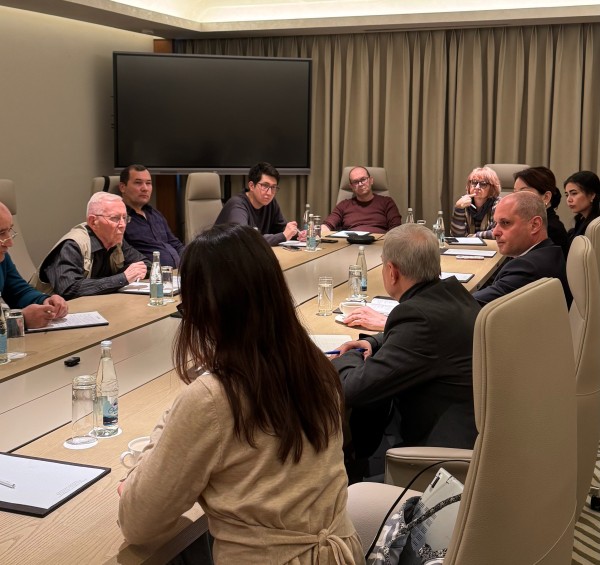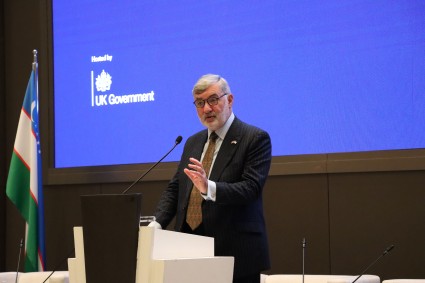
The UK Department for Business and Trade (DBT) hosted the UK-Uzbekistan Infrastructure Conference in Tashkent, convening policymakers, state‑owned enterprises, investors and leading UK and Uzbek companies to advance practical collaboration on Uzbekistan’s priority infrastructure agenda.
The conference opened with a welcome by HE Timothy Smart, British Ambassador to Uzbekistan, followed by keynote addresses from The Rt Hon Lord Alderdice, the UK’s Trade Envoy to Central Asia and Azerbaijan, and HE Jamshid Khodjayev, Deputy Prime Minister of the Republic of Uzbekistan, who underscored the growing strength of UK–Uzbekistan economic cooperation and highlighted infrastructure as a central pillar for future trade and investment partnership. The keynote discussions framed the day’s agenda around bankability, the role of international expertise, and the importance of predictable project pipelines.
Transport infrastructure emerged as a major theme, with experts from PwC, the Ministry of Transport of Uzbekistan, Uzbekistan Airports, Arup, Zaha Hadid Architects and Korea Eximbank examining how Uzbekistan can structure rail, airport and station modernisation to meet investor requirements. Speakers emphasised the need for integrated planning, early-stage feasibility preparation and financing models that can attract international capital to complex transport assets.
Urban development and digital construction drew significant interest as Foster + Partners, Worley, Tashkent Invest, Cross Works, Buro Happold and Connected Places Catapult explored how master‑planning, regeneration strategies, cultural assets and digital design tools can shape the next generation of Uzbek cities. Discussions highlighted the importance of design quality, digital twins, and modern delivery standards to support efficient and sustainable urban growth.
Financing and investor confidence were central to a session involving LBBW, the Ministry of Economy and Finance of the Republic of Uzbekistan, ADB, MUFG Bank UK, JP Morgan and UK Export Finance. Participants discussed the qualities that make projects bankable, including robust risk allocation, realistic timelines, structured PPP frameworks and early engagement with commercial lenders and IFIs. The session also underscored UKEF’s role in enabling competitive financing for UK‑linked infrastructure delivery.
The essential infrastructure segment brought together the Ministry of Energy, the Ministry of Healthcare, Infrasia Capital and Intec Energy Solutions, focusing on grid modernisation, energy distribution and the development of modern healthcare facilities. Speakers stressed the value of international technical expertise and private-sector partnerships in addressing rising demand for resilient power systems and improved medical infrastructure.
The conference concluded with an optional UKEF workshop offering practical guidance on small‑scale transactions under the standard buyer loan guarantee scheme, followed by B2B meetings that enabled UK and Uzbek companies to explore commercial opportunities and advance early partnership discussions.