On November 28, the Cabinet of Ministers issued a resolution on phased implementation of Eco-Transport system, aimed at reducing harmful vehicle emissions and improving air quality.
The resolution also approved regulations on vehicle diagnostics and issuance of environmental stickers.
In line with the Uzbekistan 2030 strategy, vehicles that fail to comply with the Euro 5 standard or higher will be gradually restricted in Tashkent, Nukus, and provincial centers until 2030.
In phase 1, the Eco-Transport system will be operational in Tashkent on January 1, 2026.
The resolution provides for:
- creating environmental zones in the regions based on actual air quality and international experience;
- creating an electronic environmental map;
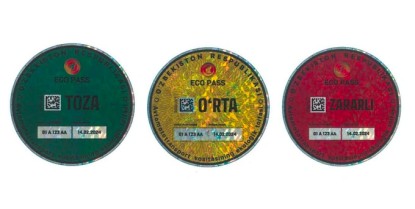
- classification of vehicles into emission categories according to pollutant (carbon monoxide, CO) emission standards: clean (green), medium (yellow), and harmful (red).
The category shall be determined by vehicle's emission class (Euro or similar standards) or by the findings of a diagnostic test. Stickers will be printed automatically at Road Traffic Safety Service (RTS) offices and issued along with registration certificate.
Starting January 1, 2026, the technical documentation of domestically manufactured vehicles must indicate their emission class.
Information on emission class shall be displayed in electronic registration certificates. The Interior Ministry and the Ministry of Transport will summarize and approve data on emission classes of vehicles in circulation and manufactured in the country.
All information will be entered into the Motor Vehicle Registration module of the Unified Automated RTS System.
How environmental category is determined
Vehicle's environmental category shall be determined based on the emission class approved by the manufacturer (for new and registered vehicles with a known class).
If the environmental class is unknown, the vehicle will be sent for diagnostics, where the emissions level shall be determined using an automated system and recorded in the accounting module.
The findings of diagnostic, operator information, date, and time are recorded online.
Owners of vehicles whose environmental category does not correspond to the environmental zone will face restrictions or entry bans, or will be required to pay an environmental compensation fee.
Vehicles with a confirmed environmental class will be classified as:
- gasoline/LPG: Euro 2 and above — clean category, Euro 0 and Euro 1 — medium;
- diesel: Euro 4 and above — clean, Euro 3 — medium, Euro 0, Euro 1, Euro 2 — harmful;
- hybrid vehicles, vehicles running on alternative fuels (except gas), and vehicles less than three years old are classified as clean.
Vehicle owners have the right to:
- request a metrological inspection certificate for equipment;
- if they disagree with the results, undergo a repeat inspection.
The initial determination of a vehicle's environmental category, as well as a repeat inspection (once a year), including a diagnostic examination and issuance of an environmental sticker, shall be conducted free of charge by the Road Safety Department of the Interior Ministry.
Each subsequent determination is subject to a fee, amounting to one basic calculation unit (412,000 soums).
The funds shall be distributed as follows:
- 15% to the Road Safety Department,
- 15% to the Center for Innovative Projects of the Ministry of Internal Affairs,
- 70% to the state budget.