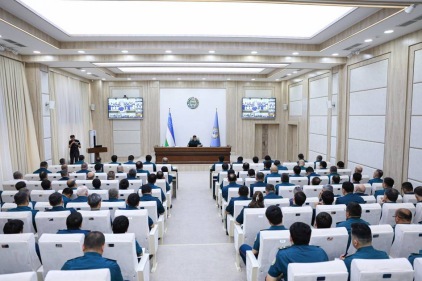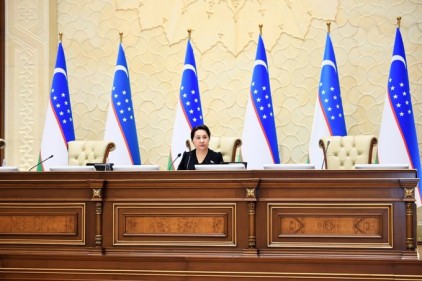
The Senate approved a constitutional bill on the Presidential Administration on August 7. For the first time a bill establishes the legal status of the Presidential Administration, its core functions, and the procedures governing its work and its interactions with other branches of government.
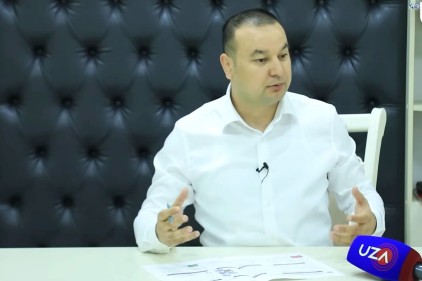
Presenting the bill at the plenary session, Abdulkhakim Eshmurodov, chairman of the Senate Committee on Judicial and Legal Affairs and Anti-Corruption, said the constitution empowers the president to establish an administration to provide organizational, legal, and analytical support for exercising his powers. Until now, however, the administration's own legal status had never been defined by bill.
He said the administration's dealings with other state bodies, along with matters of enforcement discipline, coordination, monitoring, and analytical work, had largely been governed by subordinate regulations rather than legislation. The new constitutional bill is meant to place these relationships on a statutory footing.
The bill comprises 34 articles. It defines the Presidential Administration as a state body that ensures the president can exercise his powers in organizational, legal, and analytical terms, while also helping government bodies work together in a coordinated way.
Under the bill, the president forms the Administration and appoints and dismisses its chief.
The document also sets out the Administration's guiding principles and structure, regulates its relationships with government bodies and state organizations, and provides guarantees for its officials, management, and support staff.
Senators said that in drafting the bill, they studied the experience of the United States, Finland, the Czech Republic, Slovakia, Romania, Latvia, and Kazakhstan, where the legal status of presidential administrations, chanceries, or offices is governed by dedicated legislation.
Ties to parliament, government and local administrations
During the debate, Senator Pokiza Akhmedjanova said certain provisions of the bill define the Administration's relationship with the two chambers, the Cabinet of Ministers, and local executive authorities.
She said the document sets clear boundaries and formats for this cooperation, which is intended to help coordinate the work of government bodies while preserving a balance of power between them.
The bill also assigns the Administration responsibility for advancing strategic and priority projects and for narrowing economic, social, and environmental disparities between regions.
Other provisions address state personnel policy, including performance evaluations for senior officials based on specific indicators — a measure the senator said should increase accountability among leadership.
Public engagement and oversight of implementation
Senator Khusan Ermatov noted that one of the Administration's priority tasks under the bill is to maintain an open dialogue with the public and business community and to handle appeals from citizens and organizations.
Another provision calls for systematically tracking the progress of reforms — a mechanism officials said would help ensure that presidential directives and decisions are carried out.
"Passing this constitutional bill will put an end to excessive bureaucracy in state bodies and strengthen enforcement discipline," he said.
Senate Speaker Tanzila Narbaeva noted that the bill had been reviewed in parallel with the Legislative Chamber and discussed by all Senate committees.
"There were no questions, because sweeping reforms are being carried out across every sector of the republic," she said.
She added that the bill should improve the legal mechanisms governing cooperation between state bodies, local governor and mayor offices, and other organizations, and make public administration more effective.
Senators approved the constitutional bill unanimously, with no votes against and no abstentions.
The Legislative Chamber passed the bill in its first reading on August 4, then approved it in its second and third readings on August 6. The bill was not published for public discussion beforehand.
The legislation stems from amendments to Article 109 of the constitution that took effect on July 25, which require that the Presidential Administration's legal status, core functions, procedures, and powers be defined by bill. Previously, its status had no statutory basis, and its dealings with state bodies — along with questions of enforcement discipline, coordination, monitoring, and analytical work — were governed mainly by subordinate regulations.
While reviewing the bill, lower-chamber deputies debated, among other things, the Administration's authority to review bills before the president signs them, its role in coordinating anti-corruption compliance units within state agencies, and its interaction with local councils. Nuriddin Ismoilov, chairman of the Legislative Chamber, had proposed at the time that repeat legal, financial, and anti-corruption reviews of bills already passed by parliament not be made mandatory in every case.
On August 6, Jahongir Shirinov, chief of the relevant committee, said that after consultations with experts and scholars, the provision had been revised: a clause that would have made various reviews of legislation compulsory before presidential signature was removed from the bill.
A further amendment was made to Article 20, adding a provision under which the Presidential Administration not only coordinates the work of state bodies subordinate to the president but also organizes performance evaluations of their activities.
Stay up to date with all the latest news: