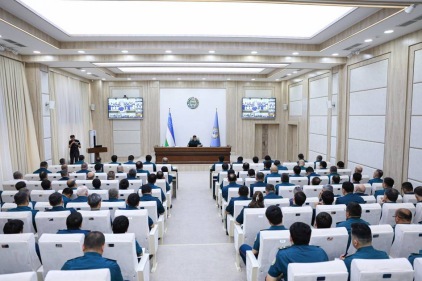
The Legislative Chamber passed a bill in its first reading today aimed at simplifying registration procedures for individuals at their place of residence and temporary stay.
The bill is designed to address problems faced by owners of mortgaged homes, students living in dormitories, and individuals unable to register at properties that are under a legal restriction or seizure order.
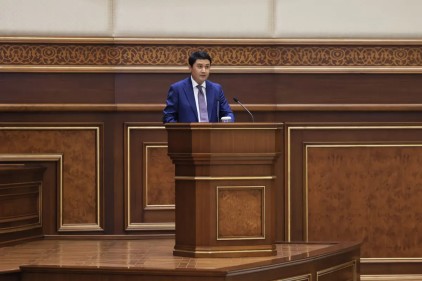
The bill was introduced by a group of lawmakers from the Adolat Social Democratic Party faction and presented by MP Shukhrat Yakubov, whose remarks were reviewed by Gazeta.uz.
According to Yakubov, lawmakers identified a number of practical problems related to residency registration, including the inability to register at homes purchased through a mortgage, difficulties registering students in dormitories, and inconsistent application of minimum floor-space requirements for temporary registration.
More than 20,000 mortgage-holders affected
Yakubov noted that under current law, any restriction placed on a residential property is grounds for denying registration at that address.
"Looking at Tashkent alone, during our review we spoke directly with Toshkent Qurilish Invest and its responsible staff, as well as with individuals who purchased apartments in high-rise buildings built under mortgage programs. Our analysis shows that more than 20,000 young families and individuals who bought housing using mortgage loans face certain obstacles in registering at their own apartments," the lawmaker said.
He added that a similar problem exists in the provinces.
As a result, individuals who purchased housing through a mortgage or subsidy are not always able to register at apartments they legally own. This, in turn, creates difficulties enrolling children in schools, attaching to primary healthcare providers, receiving pensions, and accessing other social services.
Minimum floor-space rule dropped for temporary registration
One of the bill's provisions concerns the minimum floor-space requirement for housing. Its current application to temporary registration can be interpreted inconsistently and, in some cases, becomes grounds for refusal, Yakubov said. The bill proposes eliminating this requirement for temporary registration altogether.
A separate issue, the lawmaker said, concerns student dormitories. In recent years — particularly in Tashkent — dormitories have not always been able to guarantee the legally required floor space per student, complicating temporary registration. The bill provides a separate legal solution for dormitories to remove this obstacle.
Registration to be allowed even for restricted or seized properties
Another section of the bill addresses homes that are under a legal restriction or seizure order.
As noted during the session, many individuals who purchased housing through a mortgage loan or subsidy struggle to register at their own apartments, which can create difficulties enrolling children in school or kindergarten, attaching to a clinic, or accessing pensions and other social services.
The bill proposes allowing property owners and their close relatives — parents, spouses, children (including adopted children), full and half-siblings, grandparents and grandchildren — to register at such properties without requiring approval from the entities authorized to accept the property as collateral or to impose or lift a restriction or seizure order, including banks, courts and the Compulsory Enforcement Bureau.
Lawmakers say this would allow owners and their family members to register at properties they own even while such encumbrances remain in place.
At the same time, to protect the interests of lienholders and government bodies, the bill proposes a mechanism requiring the prior written consent of the person being registered, who would need to agree in advance that their registration could later be canceled. Under the proposed procedure, registration could be revoked at the request of the lienholder or the authority that imposed the restriction or seizure order.
The bill's authors believe this mechanism would strike a balance — safeguarding individuals' constitutional rights while also protecting the rights and legitimate interests of creditors and government bodies.
MP Saidullo Azimov backed the bill's overall concept but proposed broadening it further ahead of the second reading to cover cases where a property restriction arises not from a lien but, for example, from an unpaid administrative fine or other debt.
He noted that registration restrictions are not limited to mortgages and liens. "There are cases where there's no lienholder at all — for instance, the Compulsory Enforcement Bureau may temporarily restrict a property over an unpaid administrative fine or other debt. In such cases too, the owner is unable to register relatives or other individuals at their home," the lawmaker said.
In his view, the provision should be worded more broadly ahead of the second reading, allowing owners to register other individuals even when a restriction is in place, provided the registration does not create property rights for those individuals and can be revoked at the owner's discretion.
Yakubov noted that the bill also aligns with objectives set out in a presidential resolution dated July 15, 2026, on improving public services and creating additional conveniences for individuals.
Reportedly, its adoption would expand opportunities for temporary registration, simplify registration for students, enhance protections for buyers of mortgaged housing, and eliminate inconsistencies in how the law is applied.