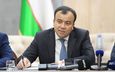
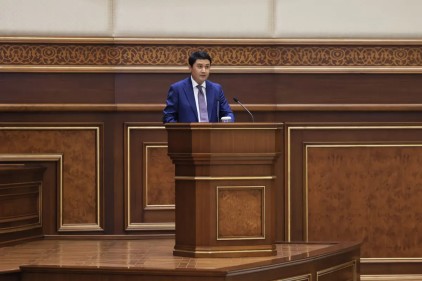
Tashkent's Yashnabad District Criminal Court continued hearing the case against former leadership of Uzbekneftegaz and representatives of contractor companies on August 7.
At the third hearing, questioning of former board chairman Bakhodirjon Sidikov concluded, after which testimony was heard from former deputy chairman Bakhtiyor Anarkulov, procurement department head Dilmurod Burkhanov, and Enter Engineering representative Ulugbek Usmonov.
None of the defendants pleaded guilty. In their testimony, they disputed both the alleged damages and the prosecution's claims about their role in decision-making.
Sidikov had completed his main testimony at the previous hearing. On August 7, lawyers representing the other defendants continued questioning him.
Rakhmatov, the lawyer representing Dilmurod Burkhanov, asked the former Uzbekneftegaz chief how the company's management hierarchy was structured and whether supervisory board decisions were binding on the executive body. Sidikov answered that they were — supervisory board decisions and directives had to be carried out.
The lawyer for Masudjon Khoshimov asked whether a face-to-face confrontation between his client and Sidikov had taken place during the investigation. Sidikov said no such confrontation had occurred.
Some questions concerned a compressor station project with Maxsusenergogaz. Sidikov explained that the original plan was later revised to cut costs, and that after reviewing the project, the company abandoned construction in its initial form. Uzbekneftegaz held a 41% stake in Maxsusenergogaz, he noted, describing it as a specialized firm with which Uzbekneftegaz cooperated on several fronts and maintained mutual financial settlements — meaning funds could have been offset or applied within the framework of the companies' broader relationship.
Questions also touched on the Tuti-Maydan gas field development project in Afghanistan, which involved contractor Eriell. Sidikov said Uzbekneftegaz was expected to eventually join the project as a shareholder with a 60% stake. He stated that the supervisory board's decision to allocate funds was based on Cabinet of Ministers resolutions and had been coordinated with the Presidential Administration, which was also kept informed of the project.
After questioning of Sidikov concluded, the court moved to testimony from former Uzbekneftegaz deputy chairman Bakhtiyor Anarkulov.
Anarkulov: 'I consider myself not guilty'
Former Uzbekneftegaz deputy chairman Bakhtiyor Anarkulov affirmed the statements he gave during the pretrial investigation and said he did not consider himself guilty.
He stressed that some of the transactions he is accused of took place before his appointment. Certain projects moved forward while he served as deputy chairman for economic affairs, but he said he was not a party to the relevant contracts.
According to Anarkulov, payments were the responsibility of another deputy chairman and the company's treasury department, which he compared to the treasury system used by the Ministry of Economy and Finance. He said a significant share of decisions were based on resolutions from the Cabinet of Ministers, the president, and the supervisory board, with asset values determined by independent appraisers.
"Recovering funds and processing documentation was not within my authority," he said.
Sale of 49% of Jizzakh Petroleum: valuations ranging from one som to $87 million
Anarkulov first addressed in detail the sale of a 49% stake in Jizzakh Petroleum, a company that later became part of Sanoat Energetika Guruhi (SANEG).
He said the supervisory board protocol authorizing the sale was dated May 26, 2021, well before he took up his post as deputy chairman. He reiterated that supervisory board decisions were binding on the executive body, and that the board's decision had already specified a price of $10 million, with no requirement in the document for an additional valuation beforehand.
Valuations of the stake, however, differed dramatically. The central point of dispute, Anarkulov said, was the value of the stake itself: KPMG, one of the global "Big Four" audit and consulting firms, valued it at roughly $87 million; Deloitte, another Big Four firm, valued it at one som; and PwC, brought in later, valued it at $15.1 million. According to Anarkulov, neither side accepted the resulting valuations.
He noted that he himself did not sit on Uzbekneftegaz's supervisory board, which was chaired by former Energy Minister Alisher Sultanov and included, among others, Deputy Ministers of Economy and Finance Akhadbek Khaidarov, Botir Khodjaev and Bobur Abdinazarov, as well as Sunatilla Bekenov.
After valuations of the 49% Jizzakh Petroleum stake diverged so sharply, Khaidarov proposed a repeat valuation, but the rest of the supervisory board did not support the idea, the defendant said. Anarkulov said that given such a discrepancy, the board should have reconvened, invited the buyer, and revisited the valuation results and deal terms — but no further meeting took place.
"The difference between one som and $87 million is enormous," he said, adding that for this reason he considers the deal effectively unfinished.
106 oil and gas fields
The next episode concerns the transfer of 106 fields and a roughly 90-billion-som discrepancy in their valuation (Gazeta.uz has previously reported on this deal in detail).
Anarkulov said the list of fields was included in a draft government resolution that underwent months of interagency review. He said the transfer was meant to occur at book value, and that the resulting discrepancy was technical in nature, calling the alleged damages figure artificially constructed. He said the process was overseen by the company's legal department.
10.4 billion soums in land tax
Another episode concerns land tax on facilities that were meant to pass to a new owner. Anarkulov said the transfer dragged on for several years, during which Uzbekneftegaz continued paying land tax — payments he estimated at roughly 10.4 billion soums in total.
Anarkulov said he did not oversee the cadastral service and described the processing of cadastral documents as a difficult problem not only for Uzbekneftegaz but nationwide. He said the case should involve requesting documents from both parties to determine why the property transfer was delayed, and that if it is found the new owner should have paid the tax, the funds could be recovered from them.
$416 million into Ark Chemical
Anarkulov then turned to the expansion of the Shurtan Gas Chemical Complex, a project he said dates back to 2018 (Gazeta.uz has previously covered the project in detail). The project was initially planned for a different site before production was relocated to the Karakul Free Economic Zone in Bukhara province, with the joint venture Ark Chemical created to carry it out.
According to Anarkulov, Uzbekneftegaz transferred $416 million as its contribution to Ark Chemical, receiving a 40% stake in return — a deal he described as very complex. He said the remaining 60% contribution from the second partner, roughly $660 million, was to be formalized progressively as construction proceeded. Anarkulov said he did not oversee the investment side of the project and could not be held responsible for the second partner's actions. He also cited limited liability company legislation, arguing that the prosecution's approach on this point was unfounded.
Uzbekistan GTL, Air Products and Enter Engineering
A separate portion of the testimony concerned Uzbekistan GTL. Anarkulov noted the plant was designed to produce environmentally friendly synthetic liquid fuels, including diesel, jet fuel and liquefied gas. He said the project's timeline slipped first because of the Covid-19 pandemic, then because of the fallout from Russia's war against Ukraine and related external restrictions.
After the plant came online, he said, defects were identified, which Enter Engineering was required to fix at its own expense. U.S.-based Air Products took part in the negotiations and agreed to finance the necessary work — around $56 million — over three years, according to Anarkulov.
He rejected the suggestion that the debt was artificially inflated in order to later be written off, noting that Uzbekneftegaz was regularly audited by Big Four international firms, which also confirmed its receivables and payables.
Regarding a disputed $21.4 million payment — in which Uzbekneftegaz settled contractor Enter Engineering's debt to Air Products — Anarkulov said the decision was approved "at the highest level" and that the Presidential Administration was kept informed. For that reason, he said, he saw no grounds to unilaterally halt the payments.
Describing his own responsibilities, Anarkulov repeatedly emphasized that his focus was the company's economics and financial stability. Uzbekneftegaz employed around 13,000 people, he said, with personnel costs alone totaling roughly 100 billion soums, while another 500–600 billion soums per month were required for taxes, excise duties and other payments to the state. He estimated daily revenue from gas and oil product sales at around 23 billion soums.
At the same time, the company had to service a substantial loan portfolio. Anarkulov said Uzbekneftegaz had repaid about $1.1 billion in outstanding loans since 2024. He said there was not a single day of delayed wages during his tenure, with staff reliably receiving an advance and their main salary twice a month.
"My job was to find the money," he said, describing his role, adding that the main goal was to prevent the company from defaulting.
Surgil, Kultak and South Kemachi
Anarkulov was also questioned about the Surgil project, which involved plans to build a compressor station with Enter Engineering's participation — specifically, the installation of a large gas turbine engine. He said he did not directly oversee construction but had visited the site and personally seen the delivered engine and the work to mount it on its foundation. He said he did not understand why this project was being attributed to him personally.
On the Kultak and South Kemachi episodes involving Maxsusenergogaz, Anarkulov noted that Uzbekneftegaz drew up an annual production program with input from Schlumberger, which prepared forecasts on where new wells needed to be drilled and where compressor stations should be built to sustain gas output.
Afghanistan
A substantial portion of the questioning focused on the Tuti-Maydan gas field development project in Afghanistan.
Anarkulov said Uzbekistan was expanding cooperation with Afghanistan in transport, energy and other sectors, noting that gas fields in the neighboring country had been known since Soviet times. Uzbek delegations traveled to Afghanistan to lay the groundwork for the project and held talks with the Afghan side. Anarkulov stressed that reports on these trips were sent to the Cabinet of Ministers, meaning — in his account — the project was not the initiative of individual company managers but was discussed at the government level. The project ultimately received all necessary approvals, he maintained.
He specifically emphasized that the disputed funds were not moved out of the country but were transferred to the company's account in Uzbekistan, and only later sent from that account to a bank in Afghanistan.
The prosecutor later named the Afghanistan project as one of the central episodes in the case against Anarkulov.
According to the defendant, Uzbekneftegaz extended a loan of roughly 332 billion soums — about $24 million — to Eriell, the contractor involved in the project, for a period of several years and at interest. He described the funds as a guarantee underpinning Uzbekneftegaz's participation in the project.
Anarkulov said Turkish and Chinese investors had also shown interest in the field, but that the Afghan side preferred to work with Uzbekistan. The mechanism for implementing the project, he said, had been set out in a classified government resolution.
Asked by the prosecutor whether the project was operational, Anarkulov said that in 2025 the work was still largely organizational — geological studies, equipment delivery and team formation — with active exploration due to ramp up in 2026. He added that Uzbekneftegaz had long been looking to expand abroad and earn revenue not just from domestic gas sales but from geological exploration, drilling and production services. Key positions on the Afghan project, he said, were intended to go to specialists from Uzbekistan.
Asked why he had no doubts about the need to finance the project, Anarkulov pointed to the fact that the field itself had been known for decades, with Soviet-era maps, geological data and other documentation available. He also noted that the project had gone through government-level approval, with the Presidential Administration kept informed.
When asked whether Uzbekneftegaz had previously issued comparable loans of $24 million, Anarkulov said he could not recall offhand and might clarify later.
Jarkurganneft: four years of litigation with the buyer
Another episode concerned Jarkurganneft.
Anarkulov cited Cabinet of Ministers Resolution No. 66 from February 2020, which concerned the enterprise in Surkhandarya province that produced a specific type of bituminous oil. Under that resolution, he said, the asset was to be valued by an international company. He said he did not understand how other valuations from a local firm had ended up in the prosecution's case materials.
The buyer, according to Anarkulov, failed to meet the agreed payment schedule, triggering a dispute that dragged on for roughly four years, during which Uzbekneftegaz went to court two or three times a year to recover the debt. The enterprise later went bankrupt.
Anarkulov cited this episode as another example of Uzbekneftegaz not always choosing its own counterparties — some companies, he said, were directly named in government resolutions. "We were required to work with them," he said.
ENGS: in-house drilling capacity fell short
Another episode involved the Russian company ENGS — at the time a wholly owned subsidiary of Eriell — and drilling at the Sharqiy Berdakh field.
According to Anarkulov, the procurement committee approved the relevant decision on July 23, 2023. At the time, he said, Uzbekneftegaz owed roughly 500 billion soums to its own drilling subsidiary, Uzneftegaz Burgilash Ishlari, whose technical equipment remained weak. A large amount of new equipment was later purchased for the company's service units.
Anarkulov said a presentation was given to the ministry and the Presidential Administration explaining the need to drill a well within roughly 150 to 180 days in order to halt declining gas output. The group's own capacity, he said, was insufficient for the task, making it necessary to bring in a foreign company. He noted that the contract with ENGS had been signed before he took charge of that area of work.
'The executive body cannot act against the supervisory board'
During questioning, Anarkulov's lawyer, Davron Akhmatov, asked him to explain how Uzbekneftegaz's management structure worked and where the company's board fit within it.
Anarkulov said virtually the entire stake in Uzbekneftegaz — 99.99% — is state-owned, held through the Ministry of Economy and Finance, with a small remaining share traded on the Tashkent Stock Exchange. The highest governing body, he said, is the general shareholders' meeting, followed by the supervisory board — a standing body that acts in the interests of the principal shareholder. Below that sits the executive body, the management board, headed by the chairman and his deputies, followed by departments, structural units, provincial divisions and subsidiaries.
The lawyer asked Anarkulov whether the executive body had the authority to disregard a supervisory board decision, revise it at its own discretion, or act against it. Anarkulov said the board had no such authority: the executive body is required to carry out supervisory board directives exactly as issued, with no power to alter their content or choose a different method of implementation. He said this order is set out in Uzbekneftegaz's charter and internal regulations.
Why Uzbekneftegaz turned to the Big Four and international ratings
Anarkulov also described Uzbekneftegaz's financial transformation and explained why international Big Four audit firms were brought in to conduct valuations.
He said the company was transitioning to International Financial Reporting Standards (IFRS), with Ernst & Young handling the relevant work. In 2021–2022, the company also obtained international credit ratings, with Anarkulov citing the major agencies Fitch, S&P and Moody's. This, he said, was necessary to raise financing directly on international markets.
Previously, Uzbekneftegaz had relied heavily on funding from the Fund for Reconstruction and Development of Uzbekistan, Russia's Gazprombank, and local banks, including Uzpromstroybank. But banks are subject to regulatory limits on credit concentration to a single large borrower — $75 million, or up to $100 million in certain cases — while Uzbekneftegaz's financing needs could reach as much as $800 million. Anarkulov explained that when borrowing through a local bank, the company effectively paid both the cost of the foreign funds the bank itself had raised and the bank's additional margin, making direct access to international markets cheaper.
After obtaining its rating, one of the company's first major financings was arranged by Deutsche Bank together with other banks, including Chinese lenders, for a loan Anarkulov estimated at around $250 million.
He also said Uzbekneftegaz's profit grew from 623 billion soums in 2023 to roughly 5.2 trillion soums two years later. He attributed the increase to higher output at Uzbekistan GTL, expanded capacity at the Bukhara oil refinery, the launch of AI-92 gasoline production, dividends from joint ventures, the placement of eurobonds, and higher gas tariffs.
According to Anarkulov, the company had repeatedly proposed raising domestic gas prices more quickly: at the time, Uzbekneftegaz was selling gas at around 600 soums per unit, while some foreign producers charged roughly 2.5 times that amount.
Please translate the following text into natural, fluent English, maintaining a professional journalistic style that matches the original tone (e.g., hard news, analytical, or investigative). Avoid word-for-word translation; instead, adapt idioms, quotes, and cultural expressions to sound authentic
How procurement worked
Anarkulov was asked who was directly responsible for setting prices in procurement decisions. He said the procurement department did not set prices on its own. The company relied on commercial bids, state procurement procedures, an electronic marketplace and auctions, while in certain cases classified government resolutions permitted direct purchases under special conditions.
Asked about the alleged criminal conspiracy, Anarkulov said the investigation had, in his view, presented no evidence linking him to most of the other defendants. He said he had never even known some of his co-defendants before the criminal case began.
After Anarkulov, testimony was given by Dilmurod Burkhanov, head of Uzbekneftegaz's procurement department, who likewise denied guilt.
At one point he summed up his view of the limits of his official authority with an image: "I'm physically capable of jumping one meter, but the investigation wants me to jump three." He said he had done everything within his role — sending letters and memos, corresponding with suppliers, and referring matters to the legal department whenever a contract went unfulfilled.
Two engines for nearly $5 million
The first episode concerns the purchase of two engines from Enter Engineering for roughly $5 million, or 64.7 billion soums. According to the prosecution's account, as Burkhanov described it, the company supposedly needed only one engine, but two were ultimately purchased.
Burkhanov said the procurement department had no authority to independently decide to buy a given piece of equipment; his unit's work began only after receiving instructions from senior management. He also rejected the claim that he, together with others, had "pushed through" the agreement.
He cited a directive from the prime minister dated January 20, 2025, followed by a subsequent order from the board chairman, as the basis for purchasing the engines. "If the order had said to buy 10 engines, I would have bought 10 engines," he said. Checking the technical condition of equipment, he added, was not part of his duties.
When problems with the equipment later emerged, Burkhanov said he sent inquiries to the supplier. Getting no result, he prepared a memo to the legal department, after which the dispute moved to the commercial court. He noted that the mere existence of defects does not amount to embezzlement — such issues can be resolved through claims procedures, settlement between the parties, or litigation.
Allegations of a falsified protocol
The next episode concerns the Russian drilling company ENGS and the Sharqiy Berdakh field. Burkhanov is accused of falsifying a procurement committee protocol — specifically, the prosecution alleges that inquiries to SOCAR and to Chinese and Kazakh companies either were never sent or that their replies never actually arrived.
Burkhanov denied this. He said the protocol was signed by all 11 members of the committee, with roughly 30 additional specialists present at the meeting. "To falsify the protocol, you'd have had to forge the signatures of all 11 committee members," he said. He maintained that inquiries to the foreign companies were sent through Uzbekneftegaz's corporate email system and that replies came back the same way — records, he said, that could be verified within the company.
Burkhanov also disputed allegations of price manipulation on the drilling of a 4.5-kilometer well, arguing that if the goal had genuinely been to artificially inflate the price, similar adjustments would have had to be made to cost calculations for other depths, such as 2 km or 5 km.
Burkhanov's testimony indicates the investigation also links roughly 59.8 billion soums in alleged damages to the fact that the work did not go to Uzbekneftegaz's own drilling subsidiary, Uzneftegaz Burgilash Ishlari. Burkhanov said the subsidiary's capabilities had been assessed for about three months before the procurement committee's protocol was drawn up, and the review concluded that its capacity was insufficient. He stressed that the procurement department itself did not make that decision — it simply recorded in the protocol what the procurement committee had decided.
37.1 billion soums in pipe supplies
Another episode concerns a 37.1-billion-soum pipe delivery from Oil Ravon Servis. Burkhanov called the allegation unfounded, saying the contract was arranged through an exchange-trading mechanism on the orders of former Uzbekneftegaz head Mehriddin Abdullayev in January 2023.
His department's role, he said, was limited to overseeing delivery until the pipes reached the warehouse of the Mubarek Oil and Gas Department. Payments, invoices and fund transfers, he said, fell under the Department of Accounting and Corporate Reporting. "Anything to do with payments isn't my responsibility," he said.
He said Uzbekneftegaz's new leadership, under Abdugani Sanginov, later ordered a review of the delivery following an inquiry. A dedicated compliance team of company specialists was set up in June of this year, which visited the site and examined the documentation and the physical movement of the pipes — where exactly they had been delivered, whether they were received at the Mubarek warehouse, and where they were subsequently used.
Burkhanov cited this as evidence against claims that the delivered pipes might not actually exist or that funds were transferred without any real delivery of goods, saying the pipes "could not simply have vanished" — their arrival should be documented in warehouse records, with subsequent use traceable through the company's internal accounting.
A dispute with a contractor over a turbine
A fourth part of Burkhanov's testimony concerned roughly 30 billion soums' worth of work, including VAT, to repair or refurbish turbine equipment. Efforts to carry out the necessary work with Siemens had initially stalled for a long period. A German company was then found that promised to complete the job faster — within 90 days — represented locally by Oilgasservisinvest, whose representative is also a defendant in the case.
That company missed its deadlines. Burkhanov said claims were filed, followed by a memo to the legal department, after which Uzbekneftegaz took the matter to commercial court, seeking the return of a 10-billion-soum advance and 4 billion soums in penalties. He said Oilgasservisinvest has since paid that amount in full.
Usmonov: 'I wasn't responsible for Enter Engineering's finances'
The last defendant to testify on August 7 was Ulugbek Usmonov, Enter Engineering's general director from 2020 to 2025, who also fully denied guilt.
Usmonov said that during his time as a company executive, he was primarily responsible for construction operations. Financial matters — banking, fund management, signing financial documents and use of the company seal — were handled by Alfonso Tengco, who acted under a power of attorney from Enter Engineering's Singapore-based parent entity.
In January 2025, businessman Bakhtiyor Fazylov became head of the company, and Usmonov continued on as his adviser. In that role, he said, his duties consisted of relaying management's instructions, gathering information on project progress and reporting to Fazylov.
Usmonov also addressed the prosecution's theory of a criminal conspiracy. He said that of the individuals named in the case, he personally knew only a few — including Shahzod Alirizayev, who does not appear among the defendants. Several other defendants, he said, he either knew only by reputation or had met for the first time in connection with the criminal case. He therefore considers the claim of a joint conspiracy unfounded.
Usmonov said the key negotiations between Uzbekneftegaz and Enter Engineering were conducted directly by Bakhtiyor Fazylov and Bakhodirjon Sidikov.
Air Products and Enter Engineering's debt
One episode concerns Enter Engineering's debt to Air Products and a payment of roughly $21.4 million tied to the Uzbekistan GTL project — a guarantee, and subsequent settlement, of Enter Engineering's debt to Air Products, covered by Uzbekneftegaz.
Usmonov said he had no part in negotiating the relevant agreement and was not involved in the financial arrangements around it, saying all matters connected to Uzbekistan GTL, along with negotiations and agreements with Air Products, were handled directly by Fazylov. He said he only learned the details of certain documents and the debt-settlement mechanism during the pretrial investigation, and reiterated that he had no authority to approve or reject payments.
He repeated that during his time at Enter Engineering he was mainly responsible for construction and had no authority to independently approve, reject or process payments — financial matters, banking and fund management, he said, were overseen by other company officials.
Later, while serving as Fazylov's adviser, Usmonov learned that Enter Engineering needed to settle its debt to Air Products. He said he recommended to management that the company avoid falling into arrears and allocate the necessary funds, since he considered it important to honor obligations to a foreign partner. However, he said he was told not to get involved in the matter — as an adviser, he explained, he could only pass along information and offer recommendations, without authority over company funds or payment decisions.
South Tandyrcha: 8.8 billion soums as an unsettled balance
The next episode concerns construction of a compressor station at South Tandyrcha. Usmonov estimated the total contract value at around $77 million, with most of the work completed. He described the remaining 8.8 billion soums not as embezzled funds but as an unsettled balance reflected in the accounts.
According to his account, work continued and the station was built, but Uzbekneftegaz declined to accept part of the completed work due to on-site defects. Once the defects are fixed and the relevant acceptance documents signed, he argued, the balance should be cleared. He stressed that all the sums in question are reflected in accounting entries and remain recoverable. On this episode, Usmonov asked the court to acquit him under Article 83 of the Criminal Procedure Code.
Surgil: 119 billion soums and underfunding
Usmonov likewise rejected the allegations concerning the Surgil project. He said the contract was worth about $78 million, with the disputed amount totaling roughly $8.5 million, or 119 billion soums. He said part of the contracted work went unfinished not because of any embezzlement, but because the project was underfunded.
He described in detail how funds from the client were approved within Enter Engineering: once money was received, special registries were drawn up listing required payments — for equipment purchases, materials and construction financing — which were then sent to Fazylov for approval. Only after Fazylov signed off, Usmonov said, could the relevant sums be released to a specific project. If a registry went unapproved or funding wasn't allocated, the project team had no way to procure equipment on time or keep work moving at the planned pace.
This, the defendant argued, explains the delay on the Surgil project. He said that money arriving from Uzbekneftegaz did not automatically mean the full amount went straight to that particular site — further allocation of funds happened inside Enter Engineering and depended on management's decisions. Usmonov stressed that he himself did not control these funds or decide which projects they went to. "I don't know where the money went or how it was allocated," he said.
At the same time, he insisted the disputed sum had not vanished without a trace, saying the movement of funds could be verified through Enter Engineering's accounting records and entries — payment registries, incoming funds and their subsequent distribution should all be documented in the company's books. He also said unfinished obligations under the project remained on the balance sheet and could still be resolved — by completing the work, offsetting obligations, or recovering the relevant sums. He therefore disputed classifying the full 119 billion soums as damages.
The Baker Hughes engine: 111 billion soums
A separate episode involves a large Baker Hughes gas turbine unit worth approximately 111.7 billion soums. Usmonov said the equipment did arrive in Uzbekistan, as confirmed by customs documentation.
In the autumn of 2024, the engine was installed on its foundation at a compressor station at the Surgil field. He described its scale, comparing its height to roughly two stories of the courtroom where the hearing was taking place; a dedicated building was constructed for it, along with a ventilation system.
After startup, an accident occurred. According to Usmonov, a foreign specialist made an error during installation or startup involving plastic protective plugs used in the process, which led to oil-related problems; the temperature rose to around 210 degrees, and the engine broke down. In November 2025, it was sent to Florence for repair. Usmonov said that, per a letter from the repair company, the equipment is expected to return to Uzbekistan after restoration in December 2026.
He argued this episode cannot be considered embezzlement: the engine exists, was brought into the country, installed, and broke down only during operation.
Two AI-series engines: one operating, one in storage
Another episode concerns two AI-series engines — used to pump gas at compressor stations — whose cost the investigation, according to Usmonov, included in the damages. These were two new engines that Enter Engineering sold to Uzbekneftegaz.
Usmonov said that by the time the relevant agreement was concluded, he was no longer involved in the company's day-to-day management and did not know the details of the deal. He said one of the engines was actually in operation while the other remains in storage, and he could not understand why the full value of both was being counted as damages. "The investigation is trying to inflate the damages figure," he suggested.
He said he learned only later that one of the units had broken down. The fault occurred during the warranty period; according to information he received, a foreign object had gotten into the engine. Repairs were to be carried out by Ukraine's Motor Sich, which insisted the unit be sent to Ukraine for inspection, arguing that Uzbekistan lacked the conditions needed for such an assessment — while the Uzbek side wanted the inspection carried out domestically. The dispute, Usmonov said, is now before the courts. He asked to be acquitted on this episode as well.
3.8 billion soums in diesel fuel
Another question concerned diesel fuel worth about 3.8 billion soums. Usmonov again said that by the time the relevant agreements were signed, the company was effectively run by Fazylov, with Tengco handling financial matters, while he himself, as adviser, knew nothing about the contract. He described the supply of fuel to Enter Engineering as an ordinary commercial relationship between the companies, saying Enter Engineering later paid off the fuel debt in full.
Assets
Usmonov separately challenged the results of an asset inventory that the investigation has linked to him. He said the list included property belonging to his younger brother and two older brothers, including assets they had inherited.
One of his brothers works in construction, Usmonov said; some apartments remain registered in his own name because buyers purchased them in installments, with ownership due to transfer to the buyers once payment is complete. A car and other property registered to his wife, he said, were likewise not purchased by him — one vehicle, for instance, was bought by his father and registered in his wife's name.
The defendant rejected the claim that all the property identified by the investigation belongs to him personally or was acquired with proceeds of the alleged crimes.
Defense for Former Uzbekneftegaz Chief Seeks Release From Custody
At the conclusion of the hearing, defense attorney Khusanov, representing former Uzbekneftegaz chief Bakhodirjon Sidikov, petitioned the court to alter his client's pretrial restrictive measure.
The defense primarily cited Sidikov's health condition as grounds for the request. His attorney argued that keeping him in pretrial detention poses additional medical risks.
Furthermore, the defense explicitly challenged the legality of Sidikov's initial arrest. Khusanov pointed out that when his client was detained in January, he was a sitting member of Karakalpakstan’s parliament, the Joqargi Kengis, and therefore held legislative immunity.
According to the defense, law enforcement failed to follow the mandatory legal protocols required to strip a lawmaker of immunity prior to arrest. The legal team views this procedural oversight as a direct violation of parliamentary privilege and a compelling argument for his release.
The attorney urged the court to consider both Sidikov’s failing health and the alleged procedural violations, requesting his release from jail in favor of a more lenient alternative, such as bail or house arrest.
The court deferred its ruling on the motion, announcing that a decision will be delivered during the next scheduled hearing.
Stay up to date with all the latest news: