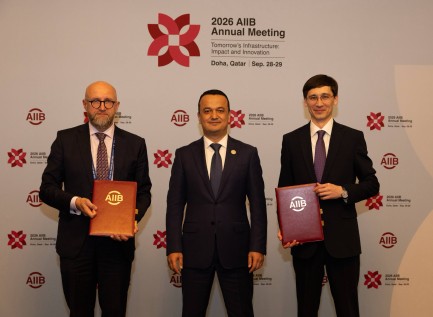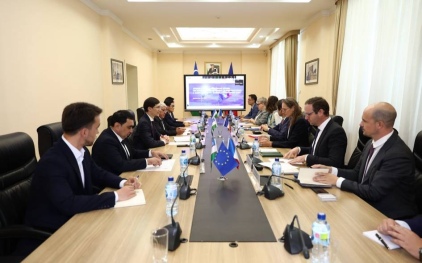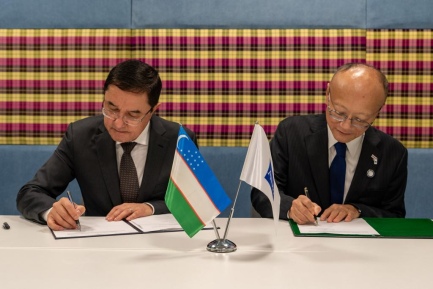
Asian Development Bank (ADB) President Masato Kanda met Uzbekistan Deputy Prime Minister and Minister of Economy and Finance Jamshid Kuchkarov today and signed a $200 million loan agreement to modernize the country’s electricity distribution system, cut power losses, and improve reliability as electricity demand rises.
“A reliable power supply is one of the most basic promises a modern economy must keep to its people,” said Mr. Kanda. “This agreement will help Uzbekistan keep that promise as demand rises, with stronger networks that serve families, businesses, and public institutions and can carry more renewable energy.”
The Modernization of Electricity Distribution Systems Program will upgrade 60 critical electricity distribution substations across Uzbekistan and introduce digital systems to improve management of the network. The program is ADB’s first energy operation under the ADB–World Bank Full Mutual Reliance Framework and the first results-based lending operation in Uzbekistan’s energy sector.
Uzbekistan’s electricity network is under growing pressure as the economy expands, cities grow, and households use more power. Aging infrastructure, electricity losses, and overloaded equipment have made it harder to provide reliable service and connect growing amounts of renewable power.
The program will rehabilitate and upgrade substations, improve network management, and strengthen the operational capabilities of JSC National Electric Grid of Uzbekistan. The investments are expected to reduce electricity losses and transformer overloading, improve reliability, help enable at least 3.3 gigawatts of renewable energy capacity, and cut greenhouse gas emissions by nearly 23,000 tons of carbon dioxide equivalent a year.
The program builds on ADB’s long-standing support for Uzbekistan’s power generation, transmission, and distribution systems, including more than $3.4 billion in financing and guarantees for the country’s energy sector since 2010. The program will also strengthen technical skills, management, and financial controls at the national power transmission utility, while supporting workforce training and greater participation of women in the energy industry.
The program supports the Uzbekistan 2030 Strategy and national goals to expand renewable energy and improve energy efficiency. It also supports ADB’s country partnership strategy for Uzbekistan, 2024–2028.
Under the Full Mutual Reliance Framework, ADB and the World Bank can rely on each other’s due diligence and implementation arrangements, reducing duplication and transaction costs. ADB is the lead lender for the program. World Bank management is expected to seek Board approval later this month for an additional $100 million.