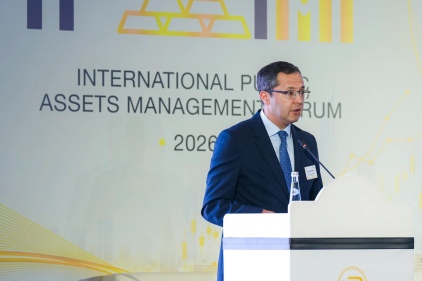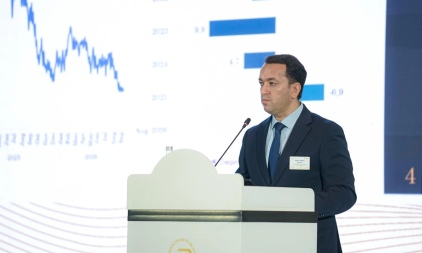
The Central Bank plans to gradually broaden the range of assets in which the country's international reserves are invested, First Deputy Governor Abror Mirzo Olimov said on September 18 at the International Forum on Sovereign Asset Management (iPAM) in Tashkent.
According to Olimov, the Central Bank held approximately 439 tonnes of gold as of early September.
"The structure of our international reserves is, one could say, quite unusual compared to other central banks. As of the start of September this year, we held around 439 tonnes of gold, with a market value of roughly $65 billion. That's about 90% of our international reserves," he said.
Why gold makes up such a large share of reserves
Olimov noted that the high proportion of gold cannot be attributed solely to the Central Bank's investment decisions. The country produces roughly 120 tonnes of gold annually, and the Central Bank has priority rights to purchase it.
"The large share of gold in our reserves isn't simply the result of a decision by reserve managers, nor is it the outcome of strategic asset allocation. It stems primarily from the structure of our economy, our domestic gold production ecosystem, and, of course, the way reserves have historically accumulated," the deputy governor explained.
He said international reserves have nearly doubled over the past five years, rising from about $35 billion in 2021 to more than $72 billion today. Over the same period, gold holdings grew from 360 to 439 tonnes, while gold's share of total reserves rose from roughly 60% to 90%.
That increase, Olimov said, reflects two factors: growth in the physical volume of gold held and the rise in the metal's global price.
"It's the combination of these two factors that has pushed gold's share of international reserves up to around 90%," he said.
Olimov expects gold's role in central bank reserves worldwide to keep growing. He noted that central banks globally have purchased more than 1,000 tonnes of gold annually over the past four years — roughly double the pace of previous decades.
"The question is no longer whether gold should be part of reserves. The harder question is: what share of gold in reserves is optimal, and how should that gold be managed? And I think the most important question is what happens once gold comes to represent a significant share of international reserves," the deputy governor said.
Central Bank to look beyond U.S. Treasuries
Gold will remain a strategic reserve asset, but as the portfolio grows, the Central Bank intends to widen its range of other investments.
"That means we plan to move beyond U.S. Treasury bills and invest in other types of highly liquid assets. These could include sovereign bonds, sub-sovereign bonds and other fixed-income instruments," Olimov said.
At the same time, the Central Bank has no intention of taking on additional risk simply to diversify its holdings.
"We don't view diversification as simply adding new asset types. Before taking on more risk, you need the institutional capacity to understand, measure and manage that risk," the deputy governor said.
Between 2026 and 2027, the Central Bank is working with international financial institutions on strategic asset allocation, investment policy and strategy, and on building an independent risk-management system.
According to Olimov, there is no single optimal reserve structure that applies to every country.
"A gold-producing economy like ours, or some of our neighbors, will naturally have a different reserve structure than an import-driven economy, a financial hub, or an exporter of other commodities," he explained.
The structure of international reserves needs to account for a country's obligations, its need for currency interventions, the makeup of its domestic market, its acceptable level of risk and its institutional capacity, Olimov said.
The securities portfolio grew by just $3.4 million in August, to $1.766 billion. That compares with a decline of about $1.1 billion, or nearly 40%, in July — from $2.86 billion to $1.76 billion — the first such drop since securities were added to the reserve structure.
As of September 1, gold and foreign exchange reserves stood at more than $72 billion, with the securities portfolio within that total at $1.77 billion, up just $3.4 million for the month — about 2.4% of total international reserves. In early July, by comparison, the securities portfolio stood at $2.86 billion before shrinking by nearly 40% over the month to $1.76 billion.