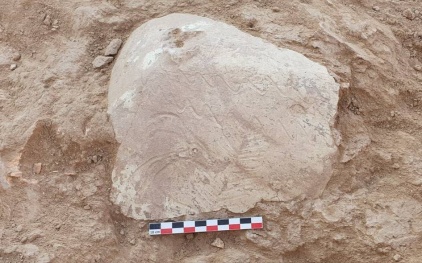
Excavations at the Odirmon urban archaeological site in Kamashi district have uncovered an altar linked to religious rites and a rare ossuary, the Cultural Heritage Agency reported.
The dig, led this year for the first time by Sanjar Abdurakhimov of the Samarkand Institute of Archaeology, focused on the site's northeastern section, where the altar was found. Measuring 70 centimeters high and 90 centimeters wide, the structure retains clear traces of fire damage. Its floor was laid with fired, tile-like bricks measuring 18 by 28 by 2.5 centimeters, while the surrounding walls were coated in a clay plaster layer 2.5 to 3 centimeters thick.
Multiple layers of renewed plaster suggest the altar was used over an extended period and underwent regular repairs.
The ossuary recovered at the site bears carved motifs resembling deer and juniper trees on its outer surface. Researchers expect to study these depictions in greater depth once restoration work is complete.
Preliminary findings date the Odirmon site to between the 3rd century BC and the 3rd century AD. Experts say the altar and ossuary offer valuable insight into the religious beliefs, rituals and burial customs of the ancient population that once inhabited the area.
Continued excavation is expected to shed further light on the site's historical and cultural significance.
In a separate case, a resident of Darvozagaza village in Samarkand province's Payariq district reported uncovering ancient artifacts while digging in his yard. The excavation turned up human skeletal remains alongside bronze bracelets, various ornaments and small beads.
The resident notified the Yahyo Gulomov Institute of Archaeology in Samarkand, whose specialists visited the site to examine the finds. All artifacts were formally registered and taken in for scientific study.
Stay up to date with all the latest news: