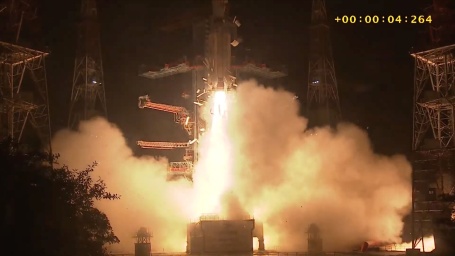
India's space agency successfully launched its first imaging satellite designed for geosynchronous orbit in the early hours of Friday, marking a significant addition to the country's earth observation fleet.
The Indian Space Research Organisation (ISRO) confirmed that its GSLV-F17 rocket lifted off precisely on schedule at 2:55 a.m. from the second launch pad at the Satish Dhawan Space Centre in Sriharikota, following a smooth 27-hour countdown. Carrying a payload of 2,367 kilograms, the rocket placed the EOS-05 satellite into its intended sub-geosynchronous transfer orbit roughly 18 minutes after liftoff, before the spacecraft moves on to its final geosynchronous position.
Once operational, EOS-05 will deliver real-time imagery to support a range of applications, from agricultural monitoring to disaster response — capabilities officials say will be considerably enhanced by the satellite's unique vantage point. Unlike most earth observation satellites, which orbit at low altitude and pass over any given location only periodically, EOS-05 will effectively hover in place relative to India, offering continuous, uninterrupted monitoring rather than intermittent snapshots.
ISRO Chairman V. Narayanan said the mission represents a major step forward for India's earth observation program, strengthening the country's ability to gather and deliver critical environmental and geospatial data.
Recent momentum for India's space program
Friday's launch adds to a string of milestones that have reshaped India's standing in global spaceflight over the past several years. In 2023, ISRO's Chandrayaan-3 mission made India the first country to successfully soft-land a spacecraft near the moon's south pole, a feat quickly followed by the launch of Aditya-L1, the nation's first dedicated solar observatory. That same year, ISRO also advanced its human spaceflight ambitions with early testing under the Gaganyaan program.
The momentum continued into 2025, when ISRO conducted its SpaDeX docking demonstration, proving out satellite rendezvous and docking technology considered essential for future space station and crewed missions. In July 2025, India further expanded its scientific footprint with the launch of NISAR, a jointly developed satellite with NASA and the world's first satellite to use dual-frequency radar imaging, designed to track subtle changes in Earth's surface linked to earthquakes, landslides, glacier movement, forests and agriculture. That year also saw an Indian astronaut gain hands-on orbital experience through the Axiom-4 commercial mission, seen as valuable preparation for India's own human spaceflight effort.
Looking ahead, ISRO is now working toward the uncrewed test flight of its Gaganyaan human spaceflight program, with two uncrewed missions expected in 2026 and the first crewed flight targeted for 2027. The government has also greenlit ambitious follow-on missions, including a Venus orbiter and Chandrayaan-4, a lunar sample-return mission, alongside plans for India's own space station later this decade — underscoring a space program that has moved from periodic milestones to a sustained, multi-front expansion.
Stay up to date with all the latest news: