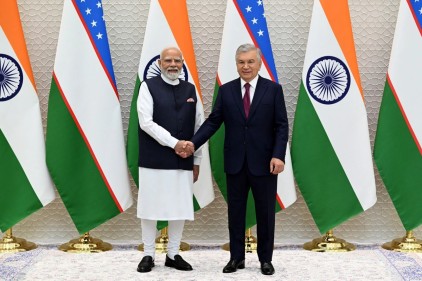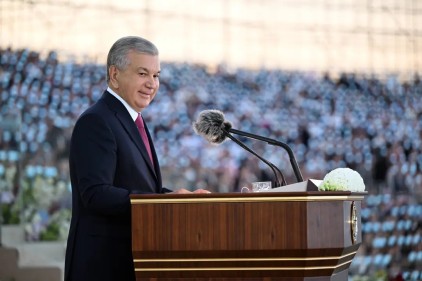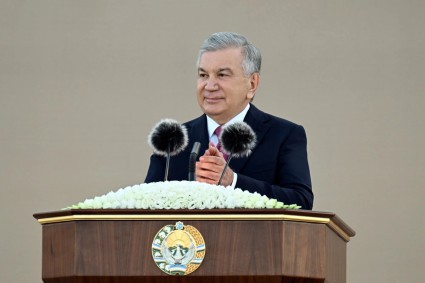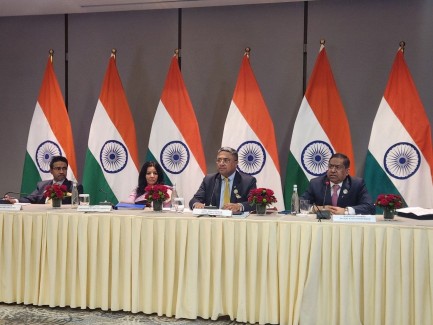
The Prime Minister Modi was conferred with Order of “Oliy Darajali Do‘stlik”, meaning “Friendship of the Highest Degree”, the highest State honour of the Republic of Uzbekistan. The honour reflects the importance attached by Uzbekistan to its relationship with India and to Prime Minister Modi's contribution to strengthening bilateral ties, the Ambassador Sibi Geroge, the Secretary (West) at the Indian Ministry of External Affairs, said at the press briefing in Tashkent Sunday.
"A significant outcome of the visit was the elevation of India-Uzbekistan relations to a Comprehensive Strategic Partnership, to reflect the growth in partnership and also to give a vision for expanding the relation for the future. The two sides also agreed to establish a mechanism at the level of the Foreign Ministers to follow up on the various strands of the partnership and provide direction", he noted.
"On trade and economic cooperation, bilateral trade currently stands at around USD 1 billion. The two leaders have set an ambitious target of USD 5 billion by 2030. Discussions focused on expanding economic engagement in areas such as mineral resources, textiles, healthcare and pharmaceuticals, agriculture and food processing."
"The two sides agreed to work towards reducing trade barriers, improving banking and payment connectivity, and developing more efficient regional supply chains."
"In this context, a network agreement signed recently between NPCI International Payments Limited (NIPL), the international arm of India’s digital payment ecosystem, and NIPC, and HUMO. This represents an important first step towards establishing greater interoperability between the digital payment ecosystems of our two countries. Upon implementation of the arrangement, expected in a year’s time, Indian travellers visiting Uzbekistan will be able to use their UPI-enabled applications," the Ambassador George added.
On environment, the two leaders noted convergence between Uzbekistan's Yashil Makon initiative and India's Plant for Mother initiative. In this context, Prime Minister Modi announced a USD 1 million partnership with Uzbekistan for rehabilitation efforts in the Aral Sea region, under the Government of India's Grant-in-Aid framework.
The Prime Minister also announced 100 Lal Bahadur Shastri Scholarship for Hindi Language for meritorious Uzbek students, honoring the memory of former Prime Minister Shri Lal Bahadur Shastri at the 60th anniversary of his passing in Tashkent.
He also announced the establishment of an ICCR Sanskrit Chair at the Tashkent State University of Oriental Studies, further strengthening the longstanding academic and civilisational links between our two countries.
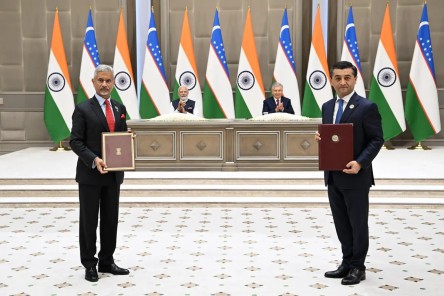
On the shared Buddhist heritage, a Letter of Intent was exchanged to support the conservation and restoration of the Buddhist heritage sites of Fayaz Tepa and Kara Tepa in Termez region of Uzbekistan. The two sides also agreed to expand cultural exchanges covering music, dance, literature, archives and the arts.
The two leaders agreed to deepen cooperation in Ayurveda and traditional medicine, including through joint research and greater institutional cooperation.
The leaders also discussed further strengthening defence and security cooperation. As part of our cooperation in humanitarian assistance and disaster relief, Aarogya Maitri BHISM Cubes were recently handed over to the Armed Forces of Uzbekistan to augment their disaster-response capabilities. India also equipped the polyclinic at the University of Military Security and Defence.
Overall, the visit has imparted fresh momentum to the India-Uzbekistan relationship. The elevation of ties to a Comprehensive Strategic Partnership, together with the substantive outcomes across education, trade & commerce, culture, traditional medicine, environment and people-to-people exchanges, provides a strong framework for taking our bilateral cooperation forward, the Secretary (West) concluded.