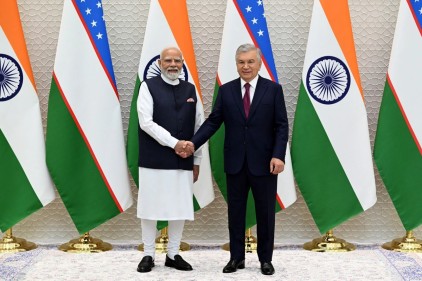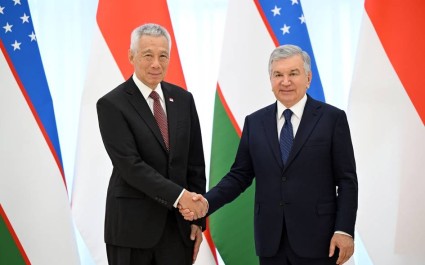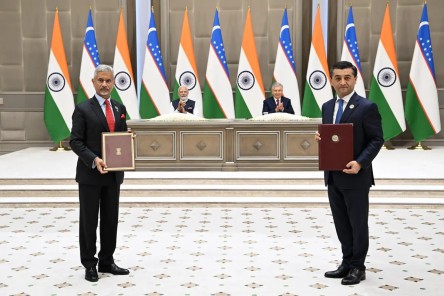
A signing ceremony for a series of Uzbek-Indian bilateral accords took place today, on August 30 at the conclusion of talks at the Kuksaroy residence, with President of Uzbekistan Shavkat Mirziyoyev and Prime Minister of India Narendra Modi in attendance.
According to the presidential press service, the following documents were signed, aimed at developing and deepening cooperation in trade and economic affairs, investment, culture and humanitarian ties, and other areas:
– Joint statement on the outcomes of the visit of Indian Prime Minister Narendra Modi to Uzbekistan;
– Program of cultural exchange between the Government of Uzbekistan and the Government of India for 2026-2030;
– Memorandum of understanding on cooperation in Ayurveda and other areas of traditional medicine;
– Agreement on cooperation in higher education and scientific research;
– Agreement on cooperation in environmental protection;
– Protocol on conducting archaeological research at the Fayaz Tepa and Kara Tepa sites;
– Memorandum of understanding on economic and financial dialogue;
– Program of cooperation in tourism for 2026-2028;
– Memorandum of understanding on cooperation in geology and mineral resources;
– Memorandum of understanding on cooperation in archival affairs;
– Memorandum of understanding on cooperation between the University of World Economy and Diplomacy (Tashkent) and the Institute of Foreign Affairs (India);
– Agreement establishing partnership relations between Samarkand province and the Indian state of Gujarat.
At the conclusion of the visit, the two leaders also held a joint meeting with members of the press to share their assessments of the outcomes of the talks.
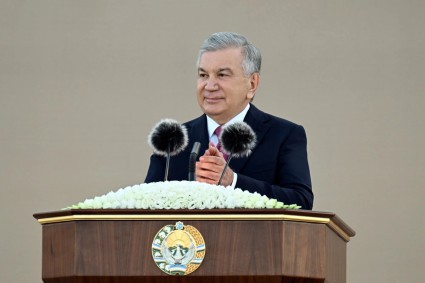
Shavkat Mirziyoyev underscored the great significance of the Indian Prime Minister's historic visit to Uzbekistan, describing India as a trusted and capable strategic partner on the global stage.
Primary attention during the talks was devoted to economic matters. Bilateral trade turnover grew by 33 percent last year to reach $1.3 billion, and the two sides have set a target of raising that figure to $5 billion by 2030.
As part of the visit, a substantial portfolio of joint investment projects was developed, with concrete agreements reached with a number of major Indian companies. Officials said the talks identified new "growth points" for deepening cooperation in energy, rare-earth and critical minerals, healthcare, pharmaceuticals, electronics, mechanical engineering, jewelry manufacturing and agriculture.
The two sides also emphasized the importance of continuing mutual support within international and regional platforms, including the United Nations, the Shanghai Cooperation Organisation, the Non-Aligned Movement, BRICS and the Global South.