President Shavkat Mirziyoyev reviewed projects in space technology, and the progress of the Samarkand-2028 satellite. The satellite, designed for Earth remote sensing (ERS), will be equipped with an artificial intelligence (AI) module.
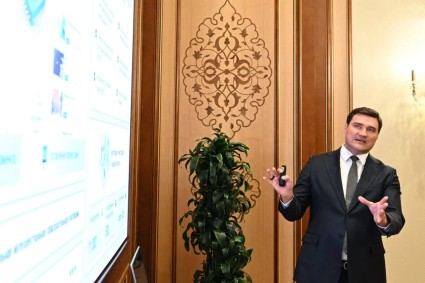
First Deputy Minister of Digital Technologies Oleg Pekos told about details of the project to Uzbekistan 24 TV. The satellite will be launched in collaboration with Chinese partners:
"In 2026, we plan to launch a satellite called Samarkand-2028 with our Chinese partners. We will provide our model for determining the vegetation of cotton and grain crops directly to this satellite."
According to him, the technology will allow image analysis directly onboard the satellite without the need to send data back to Earth.
"To minimize response time and obtain accurate images, there would be no need to send Earth observation images back to Earth and then immediately provide spectral analysis—more than 22 spectra—for on-site analysis and crop identification," he emphasized.
The deputy minister noted that Uzbekistan would be in charge of AI models, "because we have extensive experience in identifying cotton crops and their vegetation," while China will be responsible for providing the satellite images.
According to the presidential press service, the satellite images will also be used for initial air quality assessments and monitoring agricultural crops and forests.
On November 24, Uzcosmos announced the signing of a strategic memorandum with the Chinese company STAR.VISION. The memorandum provides for the development of AI technologies, joint projects, the integration of scientific and technological solutions, and collaboration with universities.
The company also agreed to name one of its hyperspectral satellites "Samarkand-2028" and expressed support for the International Astronautical Congress (IAC 2028), which will be held in Uzbekistan.
The collaboration also extends to the practical application of remote sensing data—national cotton and wheat maps based on hyperspectral imagery are expected to be created.
STAR.VISION Aerospace specializes in satellite design, intelligent satellite systems, and data analysis using artificial intelligence.
In April 2014, Kazakhstan launched the KazEOSat-1 remote sensing satellite from the Kourou Cosmodrome. It is designed for space imaging of Central Asia for government agencies. The satellite was built by the French company Airbus Defence and Space (formerly EADS Astrium) on the Leostar-500-XO platform under a contract between Kazcosmos and Airbus.