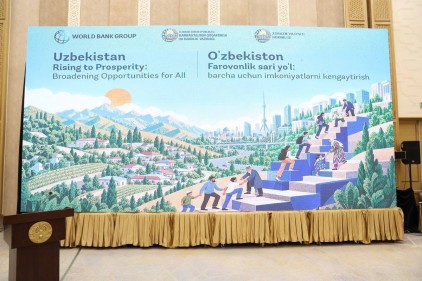
Rising employment and wages in Uzbekistan have driven a historic reduction in poverty in recent years, according to a new World Bank report, "Uzbekistan Poverty and Equity Assessment." The report examines progress in cutting poverty and expanding the middle class, and outlines measures that could help lock in these gains and extend their benefits to a wider share of the population.
According to the report, the poverty rate, measured against the national poverty line, fell from 17% in 2021 to 5.8% in 2025, lifting 3.7 million people out of poverty. That makes Uzbekistan's poverty reduction among the most significant of any middle-income country in the world, driven mainly by growth in wage employment and rising salaries.
At the same time, the quality of these new jobs needs to improve, the report's authors note. Two-thirds of new jobs are currently concentrated in construction and trade, about 85% of them informal, while real labor productivity has begun to decline.
"This means it is not just about creating more jobs, but about improving their quality. That requires developing the private sector, encouraging high-productivity, formally registered jobs, and expanding employment opportunities outside Tashkent," the World Bank said in a press release.
Among the report's other findings: the middle class is expanding rapidly, but the rise in living standards has been uneven across provinces. The middle class's share of the population grew from 37% to more than 72%, though one in five residents remains at risk of slipping back below the poverty line.
The most affluent segment of the middle class is concentrated overwhelmingly in Tashkent, reflecting the fact that the capital and Tashkent province together account for half of all jobs requiring high qualifications. Since 2021, the number of Tashkent residents belonging to this affluent segment has more than quadrupled.
Women's access to the labor market remains significantly constrained, the authors add. Among economically inactive adults in poor and vulnerable households, 92% are women. Most of them attribute their inactivity to caregiving responsibilities for family members, and mothers of children under age 2 are 36% less likely to be employed. Even employed women face a persistent pay gap of 35% to 40% compared with men.
The World Bank believes that investing in human capital and strengthening the social protection system could help sustain these poverty-reduction gains. About 80% of 15-year-old students fail to reach the minimum proficiency level in core subjects, and higher-education enrollment ranges from 63% in Tashkent to as low as 23% in some provinces.
Between 2022 and 2025, as poverty declined, the share of households covered by the country's main cash-transfer program — benefits for low-income families — fell from 26% to 8%, leaving many families at risk of poverty without social support.
Policy recommendations
The report recommends ensuring equal access to opportunities for improving welfare, stressing the need to raise the quality of general education and expand full-day schooling in underdeveloped districts. It also calls for expanding access to vocational and higher education in science, technology, engineering and mathematics (STEM) and information and communication technology (ICT), with particular attention to building skills in demand in local labor markets.
The report further recommends improving transport and digital connectivity between remote, underdeveloped areas and economic centers, and increasing the supply of affordable rental housing in cities that drive growth — steps that would lower the cost of relocating to areas with better job prospects.
Women's participation in economic activity should be expanded, the authors advise, which requires making childcare more accessible, including financially, and implementing targeted support measures for families with young children. The report also recommends expanding vocational training programs that prepare women for higher-paying sectors, paired with job-placement assistance.
The World Bank further recommends steps to make fiscal policy and the social protection system more equitable, including restoring and improving mechanisms for targeting benefits to low-income families. It also recommends creating social protection mechanisms that can respond quickly to economic shocks, and redirecting funds currently spent on untargeted energy subsidies toward more effective, targeted assistance for people in need.
Stay up to date with all the latest news: