A journey beginning in Tashkent may include a business meeting, a family visit and several nights in another country before the return flight. Tickets and accommodation usually receive careful attention. The chargers that keep travel documents, maps and work files accessible can receive much less.
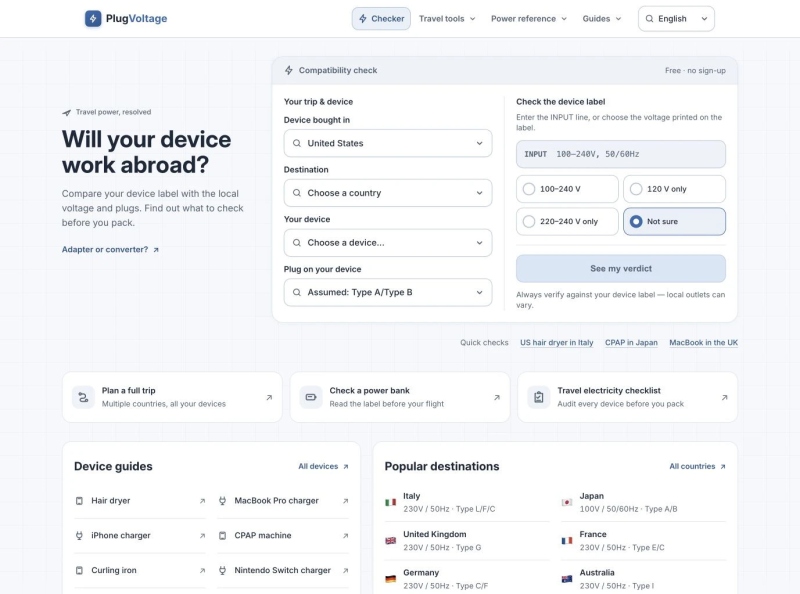
PlugVoltage interface. Screenshot of the actual website.
Before departure, make a separate power checklist for the route. PlugVoltage is one reference for researching travel-power questions, but the ratings on your actual equipment and the conditions at your accommodation still need individual checks.
List the stops where you will use a wall outlet
Write down the countries where you expect to stay, including any stopover with an overnight hotel visit. Distinguish these from a short connection where you may not need to use a mains outlet. A route list makes it easier to avoid buying accessories for places where you will never charge your equipment.
For the destinations it covers, the country outlet reference provides starting information about supply and plug types. Do not assume every country is covered by every tool, or that country-level information describes each individual building. Ask the accommodation provider about an uncertain arrangement.
Inventory the equipment you actually carry
Record the phone, laptop, camera or e-reader, along with the charger and cable each requires. Add the exact model numbers where similar accessories might be confused. A shared family bag is easier to manage when every item has an identified owner and a clear place.
For a device with an external charger, photograph its AC INPUT label. This specifies what the charger accepts from the mains. OUTPUT describes what it delivers to the device. The two sets of numbers answer different questions and should not be substituted for one another.
Check electrical compatibility before plug shape
Compare the actual input rating with the destination supply, then check frequency, plug connection, grounding and the manufacturer instructions. A wide input-voltage range does not remove those other requirements. If the label is unreadable or an essential condition remains unknown, resolve it before using the equipment.
A travel plug adapter changes the physical connection. It does not change voltage or frequency. Do not assume that an accessory described as universal makes every appliance suitable for a foreign supply. Heating appliances and specialist equipment need their own model-specific assessment.
Keep the charging plan realistic
Choose compatible cables and supplies for the devices you need, rather than packing every spare in the drawer. If several devices will share a charger, check the supported charging modes and power distribution in its documentation. Matching USB-C connectors alone do not establish suitability.
Save essential tickets, contact information and booking details for offline access. This does not replace charging preparation, but it reduces dependence on a live connection while you are locating your accommodation or speaking with transport staff.
Use a checklist at both ends of the journey
The travel electricity checklist can help organise a final review. Record your own confirmed equipment information and keep unresolved questions visible. A checklist is useful because it makes omissions easier to notice, not because it certifies an electrical installation.
- Photograph and identify the charger labels.
- Confirm the required connection accessories for the route.
- Remove damaged chargers and frayed cables.
- Keep one essential charging set easy to reach.
- Check wall sockets and bedside tables before leaving each room.
When you arrive, inspect the actual outlet and accessory conditions. If something is damaged or does not match expectations, ask the accommodation staff for a suitable alternative. The best charging plan is prepared before departure and checked again against the place where the equipment will actually be used.