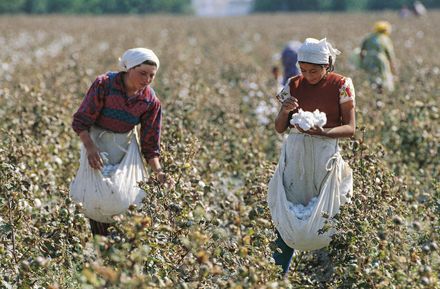
Cotton growers have switched to denser planting, mechanized harvesting and a farmer mentoring system this season in a push to produce a 5-million-tonne crop in 2026, backed by 12 trillion soums in preferential loans.
The biggest change came in the field layout. Farmers abandoned the 90 cm and 60 cm planting schemes entirely and moved to a 76 cm layout. Twin-row planting at 76x10 cm now covers 670,700 hectares (75%), with single-row planting on 218,800 hectares (25%). Plant density rose to 220,000-240,000 per hectare under the twin-row scheme and 160,000-180,000 under the single-row one, up from 80,000-110,000 previously.
Nationwide, bollworm- and herbicide-resistant foreign varieties were planted on 603,800 hectares (68%). Early-maturing local varieties with high fiber quality took 285,700 hectares (32%). The Xinjiang sowing method was used on 305,200 hectares, 124,000 more than last year.
Harvesting was also transformed. A total of 2,800 picking machines brought in the crop in a single pass, cutting the picking period from two months to one. To prepare for that, growers applied defoliation and desiccation treatments in three stages. They used ethephon first, then mild defoliants, then harsher preparations with a desiccant, which sped up the opening of the bolls.
To lift yields among weaker producers, 4,658 farmers who averaged below 30 centners (3 tonnes) per hectare in 2025 were each paired with a mentor. The 946 mentors are clusters and farms that achieved 50-60 centners per hectare, at a ratio of one mentor to five mentees. Their fieldwork is monitored on the “Digital Agriculture” platform, and mentors record progress and assign tasks in a special “Mentor’s Notebook.”
Financing was arranged ahead of the season. Farms receive a subsidy of 1 million soums for every tonne of raw cotton sold through exchange trading, totaling 2.4 trillion soums, up 0.6 trillion.
Subsidies came to 1.8 trillion soums in 2025 for the 2024 harvest. The 2.4 trillion soums in 2026 relate to the 2025 harvest.
Growers also followed eight scientifically based rules covering plant density, planting scheme, nutrition and ecologically clean fields. Crops were treated with boric acid, aspirin, yeast and silicon fertilizer to improve resistance to heat, drought and pests.
Stay up to date with all the latest news: