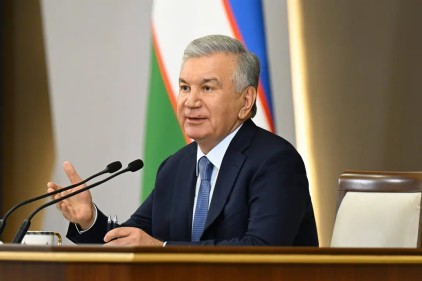
President Shavkat Mirziyoyev reviewed a presentation on prospects for advancing administrative justice to a new stage, the presidential press service reported.
Over the period under review, administrative courts have heard close to 150,000 cases, overturning more than 70,000 unlawful decisions by government bodies.
Courts have also issued roughly 27,000 special rulings referring cases of unlawful conduct by officials to higher or other authorized bodies.
These figures reflect an administrative court system built on the principle that "government bodies should serve the people, not the other way around." The system plays a key role in strengthening the rule of law within government operations and in effectively restoring the rights of citizens and businesses when those rights have been violated.
The presentation outlined proposals for the sector's next stage of development, including the deployment of roughly 15 new legal institutions informed by advanced international practice and current standards.
Under the existing framework, citizens and businesses have only one avenue for petitioning administrative courts to restore rights that have been violated. The proposed reforms would create conditions for proactively protecting citizens' rights before a violation occurs, in part by introducing four distinct types of claims that could be filed with the courts.
The reforms would also revisit the current six-month statute of limitations for filing suit. Under one proposal, citizens would be able to petition the courts without a time limit in cases where a government body has acknowledged that a violation occurred.
At present, if a citizen's rights are violated by a regulatory act issued by a local government body, there is no mechanism to challenge that act before an administrative court. The proposed reforms would grant citizens the right to challenge such regulatory acts directly in court.
Under Article 20 of the Constitution, any legal measures that government bodies apply to individuals must be proportionate and no more restrictive than necessary to achieve the purposes set out in law.
Building on that principle, the reforms envision expanding the authority of administrative courts to review whether government bodies have exercised their discretionary powers lawfully and with sufficient justification when applying such measures to citizens and businesses.
The proposals also include stronger mechanisms to ensure court rulings are carried out without exception. Under one such mechanism, if an official at a government body fails to comply with a court ruling even after being fined for noncompliance, the court would refer the matter to the prosecutor's office for further legal action.
The president backed the proposed initiatives, stressing that the new legal institutions should serve to effectively restore rights through the courts in cases of serious human rights violations, ensure the constitutional principle of proportionality functions fully in practice, strengthen accountability among government bodies, and guarantee that court rulings are reliably enforced.