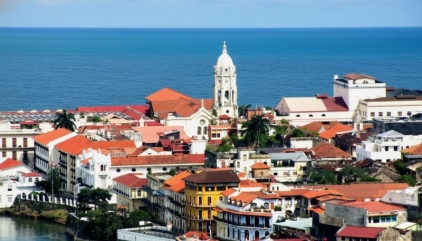
Walk a few blocks from Panama City's glass towers and the skyline gives way to narrow brick streets, wrought-iron balconies and church bells. This is Casco Viejo, the city's historic quarter, and one of the most striking urban revivals in Latin America.
A city rebuilt on a rocky point
Panama City has moved once before. The original city, now known as Panamá Viejo, was sacked and burned in 1671 during an attack led by the privateer Henry Morgan. In 1673 the Spanish rebuilt it a few kilometres away, on a small peninsula that was easier to defend, surrounded by sea walls.
That new city is Casco Viejo. Over the next three centuries it layered Spanish colonial churches with French and Caribbean-influenced townhouses from the canal era, and later Art Deco and Republican buildings. In 1997 UNESCO listed it as a World Heritage Site, together with the ruins of Panamá Viejo.
Decline and revival
As Panama City spread outward in the twentieth century, wealthier families left the old quarter. Many grand houses were divided into rooms or left empty. By the 1980s and 1990s much of Casco Viejo was in poor repair.
The UNESCO listing, government heritage rules and private investment slowly turned that around. Facades were restored, streets repaved and plazas brought back to life. Today restored buildings sit next to roofless shells still waiting for their turn, which is part of the neighbourhood's character.
What to see
- Plaza de la Independencia, the main square, where Panama declared its separation from Colombia in 1903, faced by the Metropolitan Cathedral.
- The golden altar of the Church of San José, which local legend says was painted over to hide it from Morgan's men.
- Plaza de Francia and Las Bóvedas, at the tip of the peninsula, with a monument to the French attempt to build the canal and a sea-wall walk with views of the Bridge of the Americas and the modern skyline.
- The Panama Canal Museum, in a historic building on the main square, for the full story of the canal from the French failure to the American build and the 1999 handover.
- The Cinta Costera, a seafront road and promenade looping around the old quarter, popular with walkers and cyclists at sunset.
Living with heritage rules
Restoration in Casco Viejo follows strict rules. Facades, heights and historic details must be preserved, and works need approval from the heritage authorities. Projects take longer and usually cost more than new construction elsewhere in the city.
That shapes everything from the colour of a shutter to how a ground floor can be used. It also explains why the district still looks the way it does, rather than being replaced by towers.
Visiting tips
Casco Viejo is easy to reach by taxi from anywhere in central Panama City. Wear comfortable shoes for the uneven streets, start early to avoid the midday heat, and stay into the evening when the plazas fill with families and music. As in any city, keep an eye on your belongings, and stick to the restored, busier streets after dark.
A neighbourhood people want to belong to
Many visitors leave wondering what it would be like to live among these streets. Before anyone thinks seriously about it, the advice is the same as for anywhere in Panama: spend one to three weeks there, at different times of day and week, to see how it really feels.
Anyone looking further at Casco Viejo's property market should understand the heritage rules, the true cost and time of restoration, and the condition of older structures, and should have an independent lawyer and a buyer's representative check everything before signing.
For most visitors, the old quarter remains what it has been for over 350 years: the place where Panama City's story is easiest to read, one street at a time.