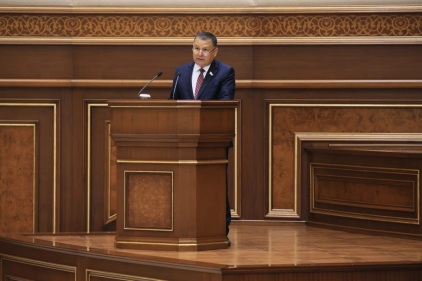
The chief of the Presidential Administration Saida Mirziyoyeva returned to Bukhara province today, August 21 to check in on a string of infrastructure and tourism projects she had set in motion during a visit just three months earlier — a follow-up that doubled as a status report on the government's promises.
Mirziyoyeva has held the post since June 2025, making her, in effect, the second-highest official in the Uzbek government's day-to-day operations. Her August visit to Bukhara followed a familiar pattern for the role: showing up months later to verify that officials actually delivered on what was pledged, rather than letting plans quietly stall.
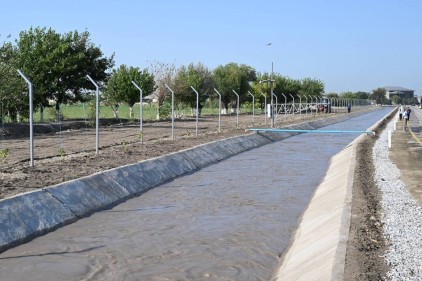
The most important among those pledges was the modernization of the Joyzar Canal, one of Uzbekistan's oldest irrigation channels, dug in 1938 to carry 16 cubic meters of water per second. Decades of silt buildup had choked that capacity down to just 5 cubic meters per second — a slow bleed of water in a country where agriculture depends heavily on efficient irrigation.
In May, officials laid out plans to concrete a 22.5-kilometer stretch of the canal to stop the losses. Three months later, 9 kilometers have been completed and another 10 are underway. Once finished, the upgrade is projected to save 12 million cubic meters of water every year — enough to make a measurable dent in the province's water stress.
Fish farming moves in alongside the water savings
Officials didn't stop at conservation. A modern fish farm has now opened along a stretch of the canal, part of a broader push under a July 2, 2026, presidential decree to modernize Uzbekistan's fisheries sector through resource-efficient technology and more productive use of water resources. Rather than treating the canal purely as infrastructure to be repaired, authorities are positioning it as a foundation for new economic activity.
From "dire condition" to full rebuild
The kindergarten Mirziyoyeva visited in May offered a starker picture. Kindergarten No. 21, in Bukhara district's Sheikhoncha neighborhood, had been in continuous use for nearly 50 years and had fallen into what she described at the time as a dire state, unfit for children. That visit triggered an order for a complete reconstruction and expanded capacity — one of the more concrete, human-scale outcomes of the trip.
Betting big on tourism — including a 1,000-year-old legacy
Beyond infrastructure repairs, the visit doubled as a tourism strategy session. Officials discussed the Afshona complex, new ethnic-style guesthouses, restoration of the Joyi Muliyon Canal, and hotel and cluster development near Bukhara's new airport. Afshona carries symbolic weight beyond its name: it's the village near Bukhara where the 10th-century polymath Ibn Sina — known in the West as Avicenna — was born, and whose medical writings shaped both Islamic and European scholarship for centuries. Leaning into that legacy fits Bukhara's broader ambition: officials want to draw 10 million visitors a year and turn the city from a stopover on the Silk Road tourist trail into a destination in its own right.
The visit ended on a symbolic note, with Mirziyoyeva touring the Yetti Pir, or Seven Saints, pilgrimage sites scattered through Bukhara's historic core — a reminder that even as the city modernizes its canals and fish farms, its pitch to the world still runs through its past.
Stay up to date with all the latest news: