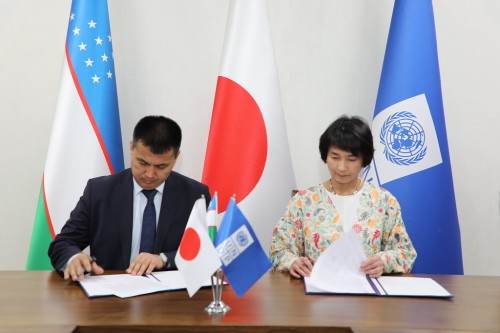
A signing ceremony held at the Ministry of Water Resources marked the official launch of the UNDP's new landmark project “Strengthening Water Resources Governance and Resilience to Climate Change in the Aral Sea Region”. UNDP and Japan partner for this transformative initiative in Uzbekistan with generous financial support from the Government of Japan with a total budget of USD 4,600,000.
The ceremony witnessed the participation of distinguished figures, including Mr. Zokir Ishpulatov, First Deputy Minister of Water Resources of the Republic of Uzbekistan; Mr. Kenji Hirata, Ambassador Extraordinary and Plenipotentiary of Japan to the Republic of Uzbekistan; and Ms. Akiko Fujii, UNDP Resident Representative in Uzbekistan. Together, they signed the Exchange of Notes and Project document, symbolizing a commitment to progress and prosperity.
The project is designed to address one of the most pressing development challenges in Central Asia. Running from 2026 to 2028, it aims to empower Aral Sea communities through integrated, climate-resilient water management, while strengthening governance, boosting water-use efficiency, increasing agricultural productivity, and building inclusive resilience.
“The drying out Aral Sea is one of the most severe environmental crises in our era. This is why Japan, as an Asian friend, has been working with Uzbekistan to mitigate negative impacts caused by the Aral Sea crisis. The project to start today is the third one in this format. I believe that the water resource management is one of the most important challenges that Uzbekistan faces”.
Japan is ready to support Uzbekistan in its efforts to promote efficient use of these limited resources by sharing Japan’s knowledges and technologies. In addition, I appreciate UNDP’s support in forming and implementing this project. I expect that their experience and expertise make this cooperation a great success, bringing tangible benefits to those who suffer from the crisis.
“I sincerely hope that these projects contribute to the water security and the fair and sustainable water management in Uzbekistan”, said H.E. Mr.Kenji Hirata, Ambassador Extraordinary and Plenipotentiary of Japan to the Republic of Uzbekistan.
“This initiative is fully aligned with the strategic priorities of the Government of the Republic of Uzbekistan in the water sector. With UNDP, we are turning the Aral Sea region into a model of adaptation, innovation, and renewed opportunity,” said Mr. Zokir Ishpulatov, First Deputy Minister of Water Resources of the Republic of Uzbekistan.
“UNDP is delighted to collaborate with the Governments of Uzbekistan and Japan in our shared mission to strengthen water governance. We are committed to introducing the best global practices to address climate impacts and water challenges through improved policy frameworks, stronger institutional capacities, and expanded access to reliable data and modern and innovative technologies. Together, we are fostering a culture of responsible water use to benefit farmers and communities in the Aral Sea Region”, said Ms. Akiko Fujii, UNDP Resident Representative in Uzbekistan. She expressed her deep appreciation to the Government of Japan and the Ministry of Water Resources for their steadfast cooperation, which continues to make these impactful results possible in Uzbekistan.
Through policy reform, institutional strengthening, and capacity development, the initiative will establish transparent and climate-resilient water management frameworks. The deployment of centralized GIS systems and real-time monitoring platforms will enable data-driven decision-making and enhance accountability at all levels. Rehabilitation of irrigation infrastructure, combined with precision irrigation, climate-smart agriculture, and innovative technologies, including wastewater reuse and renewable-powered desalination, is expected to significantly improve water efficiency and agricultural productivity for over 1,000 farmers and households.
The project is built around four interlinked components: strengthening national and local water governance institutions; advancing the digitalization of water management systems; enhancing water infrastructure and capacity for farmers and smallholders to promote food security and climate resilience; and promoting regional knowledge management, advocacy, and communication.
Alongside national impact, the project will catalyze regional cooperation through dialogue platforms and partnerships with Central Asian countries, Japan, and other regional stakeholders. Public awareness campaigns, documentary production, and forums such as the Aral Sea Culture Summit will amplify advocacy efforts and position the Aral Sea region as a model for integrated, climate-resilient water solutions scalable across Uzbekistan and adaptable to other Aral Sea-affected countries.
Gender equality is embedded as a core principle throughout the project. Women's active participation in water governance, capacity-building, and decision-making will be prioritized through targeted support, and gender-disaggregated data will guide planning and monitor inclusive outcomes throughout implementation.
Over its three-year implementation, the project will strengthen water governance institutions, modernize irrigation infrastructure, and introduce digital monitoring tools across the target districts. More than 1,000 farmers and households will benefit from improved access to water resources, climate-smart agricultural practices, and innovative technologies contributing directly to food security and sustainable livelihoods in a region long affected by water scarcity.
Through regional dialogue platforms, documentary production, and international knowledge exchange, the project will also amplify Aral Sea region's voice as a model for climate-resilient water management demonstrating that integrated, community-centered solutions can deliver lasting change for the people of the Aral Sea region.
Background: In 2023–2025, UNDP and Japan jointly implemented the project “Supporting Self‑Reliance through Climate‑Resilient Agriculture in the Aral Sea Region,” which strengthened community resilience across 4 districts, 65 settlements and improved the well‑being of more than 376,000 people. Through participatory community development, the initiative expanded access to essential services, bringing stable electricity to over 7,000 residents, clean drinking water to more than 7,700 people, and improved education and health infrastructure to over 6,200 community members. Innovative Japanese water technologies, including the “Johkasou” wastewater treatment system, were successfully introduced in key public facilities, demonstrating scalable solutions for water‑scarce environments.