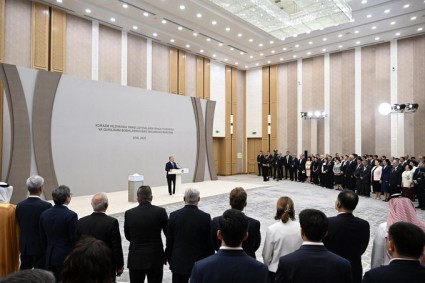
Reliable power supply remains the top concern for international investors considering data center projects in Uzbekistan, according to Bobur Khodjaev, chief of the Presidential Administration's Department for Financial Technology, Digitalization and Artificial Intelligence. He made the remarks on Monday at the Silk Road Finance & Technology Forum in Tashkent.
He said that over the past six years, the country has made significant progress in expanding its energy capacity, including through power purchase agreements (PPAs).
"We've signed a large number of PPAs. Green energy now accounts for more than 30 percent of electricity generation. That's another factor making Uzbekistan attractive to international investors looking to build data centers here, since the country can supply them with green electricity," Khodjaev said.
Betting big on Karakalpakstan
Authorities have placed particular emphasis on Karakalpakstan — the autonomous republic in Uzbekistan's arid west, best known as the region hit hardest by the Aral Sea's collapse — as the country's flagship location for data center development.
"We specifically chose Karakalpakstan for data center development because of its substantial renewable energy resources. There are already several international investors building wind and solar power plants there," Khodjaev said.
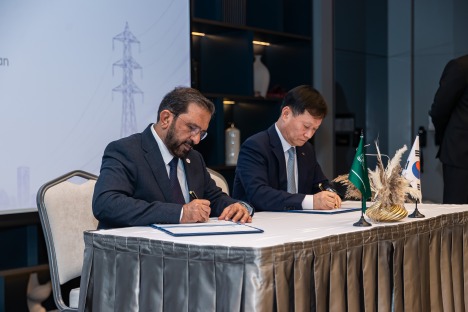
The push has already produced some of Uzbekistan's largest technology investments to date. Saudi Arabia's DataVolt has signed on for a data center partnership in the area worth up to $5 billion for as much as 500 megawatts of capacity, anchored by a special regime that offers investors electricity at five cents per kilowatt-hour — well below the country's average industrial rate of roughly eight cents. A separate $2 billion AI computing center involving Nvidia, Freedom Holding and OpenAI was announced last November, and officials have said they are courting global technology firms including Google, Microsoft, Meta and Amazon to establish operations in the region. Under a presidential decree issued last year, companies investing more than $100 million in Karakalpakstan qualify for tax breaks and infrastructure support, and Emirati developer AMEA Power is separately building a $1.06 billion, 1,000-megawatt wind farm in the area's Kungrad district.
Khodjaev said authorities are working with the Ministry of Energy to ensure future data centers receive a stable power supply.
"But of course, the reliability of electricity supply is the number one question investors ask us in negotiations," he said.
A grid racing to keep up with demand
Roman Rybalkin, director at S&P Global Ratings, who spoke on the same panel, said rapid economic growth and a rising population are driving the need for further expansion of energy capacity across the region.
"That's one of the reasons we're seeing such strong momentum behind green energy in Uzbekistan, where investors from Gulf countries are clearly playing a leading role," he said.
That momentum has been substantial: Uzbekistan has drawn nearly $35 billion in direct investment into its energy sector in recent years, according to Deputy Prime Minister Jamshid Khodjaev, adding roughly 9 gigawatts of new generation capacity and pushing total installed capacity to 25.8 gigawatts. Saudi Arabia's ACWA Power alone has invested about $15 billion in Uzbek wind, solar and green hydrogen projects, while the UAE's Masdar has put in more than $2 billion. The government has set a target of drawing 54 percent of its electricity from renewables by 2030.
Rybalkin also linked rising electricity demand to the development of nuclear power in Central Asia.
"So we're also seeing a shift toward nuclear energy. Uzbekistan has a nuclear power plant project underway in Jizzakh province, and Kazakhstan has a large nuclear plant at an early stage of development. Energy, broadly speaking, is one of the key issues on the agenda, and green energy is certainly one answer to that challenge," he said.
A strategy still being tested
Not all analysts view the buildout in Karakalpakstan without reservation. Some regional energy specialists have noted that concentrating both data centers and renewable generation in a water-scarce region carries its own risks, given that many power-generation technologies — even lower-water renewable and nuclear options — still require water for cooling and construction. Uzbek authorities have said new facilities in the region will be required to use low-water or water-free cooling systems.
BCG Managing Director Rza Nuriyev laid out what he called the "four pillars" of Karakalpakstan's development through 2035 in a presentation last year: cheap green energy, a premier site for energy-intensive industry, meat and dairy production, and niche, off-the-beaten-path tourism. Whether the region can deliver on the first of those pillars reliably enough to satisfy data center operators — companies for whom even brief outages carry steep costs — is likely to remain the central question as Uzbekistan works to convert its renewable energy ambitions into the kind of grid stability that hyperscale investors demand.
Stay up to date with all the latest news: