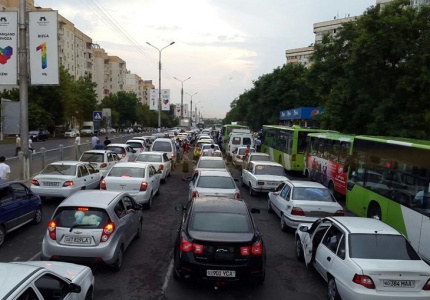
Traffic authorities in the Uzbek capital are betting that a bit of engineering can ease one of the city's most persistent headaches: gridlock on Tashkent's busiest streets. On Tuesday, the city's Road Traffic Organization Center (RTOC) announced that Shota Rustaveli Street has become the latest corridor to receive a "green wave" traffic signal system — a synchronized network of lights designed to keep vehicles moving without the stop-and-go crawl that defines rush hour in much of the city.
The rollout is part of a broader push that has already reshaped traffic flow in several parts of the capital. RTOC previously installed the system across 13 intersections along Buyuk Ipak Yuli street, around Amir Temur Square, and on a short stretch of the Small Ring Road. Shota Rustaveli now joins that growing list.
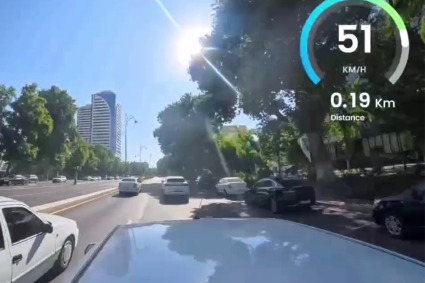
Footage released by RTOC shows vehicles cruising at around 50 km/h during test runs — right in the sweet spot the system was built for. Officials say the "green wave" is calibrated specifically for speeds of 50 to 55 km/h, meaning drivers who stick close to that range should be rewarded with a string of green lights rather than a series of red ones.
The early results, according to RTOC, are striking. Travel time from South Station toward the city center has fallen from 11.5 minutes to 8 minutes, while the return trip has dropped from 12 minutes to 8.5 minutes — a roughly 30% cut in commute time in both directions.
The mechanics behind the green lights
The concept itself is simple, even if the engineering behind it isn't. A driver who pulls away from a green light and maintains a steady speed — without hard acceleration or sudden braking — should reach the next signal just as it turns green, RTOC explained. String enough of those intersections together, and a corridor that once forced drivers to brake for every light instead lets them glide through several in a row.
But officials were careful to frame the goal as safety and consistency, not speed for its own sake. "The 'green wave' isn't designed to increase speed, but to ensure smooth and safe traffic flow," the center said, adding that the system is not meant to create shortcuts at pedestrians' expense or introduce new risks for people crossing the street.
Getting the timing right, RTOC said, is less about flipping a switch than about painstaking calibration. Engineers build traffic models and then fine-tune the signal sequencing by hand, weighing not just how cars move through an intersection but how pedestrians do too. "Traffic signal timing plans are calculated based on traffic volume, intersection capacity, and the need for pedestrians to cross safely," the center said.
Part of a wider pattern
The expansion to Shota Rustaveli Street suggests city planners view the "green wave" concept as a low-cost, high-impact tool they can extend corridor by corridor rather than a one-off pilot. With Tashkent's traffic volumes climbing alongside its population and vehicle ownership, officials appear to be betting that smarter signal timing — rather than costly new road construction — can buy meaningful relief on the streets that matter most, one intersection at a time.
Stay up to date with all the latest news: