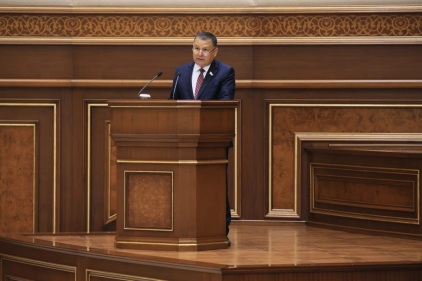
President Shavkat Mirziyoyev was briefed on progress of preparations for the sixth open dialogue with business leaders in Uzbekistan.
According to the president's press service, a national task force involving representatives from more than 50 ministries and agencies has been operating since May 15. The initiative's call center and official bots have received around 6,000 appeals, of which more than 4,200 have already been resolved favorably, while nearly 1,800 remain under review.
In addition, responsible organizations have held more than 750 meetings involving over 8,800 business leaders, during which more than 3,500 proposals and problem areas were raised.
The business ombudsman and the Chamber of Commerce and Industry separately organized more than 130 meetings attended by over 5,700 business leaders, who raised roughly 1,500 issues. Ministries and agencies are now working together on proposals to address systemic problems and amend relevant legislation based on the outcomes of these meetings.
28.5% of businesses have introduced no efficiency measures
As part of preparations for the dialogue, 5,072 business leaders from across all regions were surveyed. Domestic private enterprises made up 93% of respondents. The survey covered trade, services, industry, construction, and agriculture, and addressed business efficiency, investment, infrastructure, tax administration, foreign trade, and the judicial and legal environment.
The analysis found that businesses still have considerable room to improve labor productivity and cut production costs. Companies that had adopted digital platforms, artificial intelligence, energy-saving technologies, new products, or modern production methods reported stronger sales, competitiveness, wages, and investment levels than those that had not.
Specifically, businesses that implemented at least three efficiency measures were 4.1 times more likely to reduce production costs and 2.1 times more likely to see faster wage growth. Yet only 11.6% of businesses had adopted measures across three or more such areas, while 28.5% had implemented none at all.
More than half of businesses have deployed no new products
Fifty-one percent of businesses reported no recent introduction of new products, services, or innovations, and no modernization efforts. Over the past year, 40% of businesses made no investments, and 29% have no investment plans for the coming year either.
Business leaders cited high interest rates on loans, undervalued collateral assessments, excessive documentation requirements, and lengthy loan processing times as the main obstacles to investment.
Rising production costs
According to the survey, 38% of businesses took no steps to reduce production costs. Meanwhile, 53% of companies reported rising costs for producing goods and services, which business leaders attributed mainly to higher raw material prices as well as increased spending on energy and logistics.
Additionally, 43% of businesses had taken no energy-saving measures, and 49% do not use renewable energy sources.
Businesses continue to cite infrastructure problems
Infrastructure remains one of the key challenges for business leaders, who pointed to frequent power and gas supply disruptions, low voltage in electrical grids and insufficient gas pressure, as well as issues related to supply limits and tariffs.
The meeting also noted that despite reforms to tax administration, business leaders continue to face difficulties during inspections and in recovering value-added tax refunds. Still, 94% of respondents said the sustainability rating system has had a positive effect on their operations.
Export challenges
Only 22.3% of surveyed businesses are engaged in foreign trade. Business leaders identified difficulty finding overseas clients, product certification, logistics, financial instruments, and customs procedures as the main barriers to exporting. Businesses also cited a lack of information about foreign markets and insufficient marketing expertise.
Bureaucracy in enforcing court rulings
In the judicial and legal sphere, business leaders gave positive marks to the availability of qualified legal assistance and the transparency of government procurement. However, 73% of respondents said bureaucratic procedures during the enforcement of court rulings negatively affect their businesses.
The president directed officials to conduct an in-depth analysis of the appeals and survey results by region and sector, and to develop concrete solutions to the systemic problems hindering business development. Priority areas identified include improving business efficiency, wider adoption of innovation and energy-saving technologies, addressing lending and infrastructure issues, improving tax administration, supporting exporters, and strengthening legal protections for businesses.
For every issue raised during the open dialogue, officials have been directed to define a specific solution, an implementation mechanism, responsible parties, and deadlines.
According to a Central Bank survey for the second quarter of 2026, 64% of business leaders reported improved business conditions, and 82% expect the economy to improve over the medium term. Even so, businesses continue to cite gas and electricity outages, insufficient demand, rising fuel prices, and logistics disruptions among their main constraints.
Stay up to date with all the latest news: