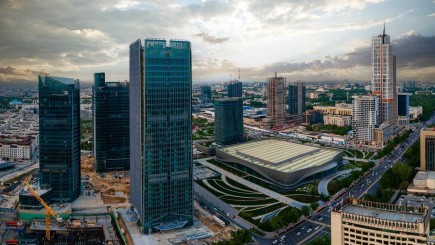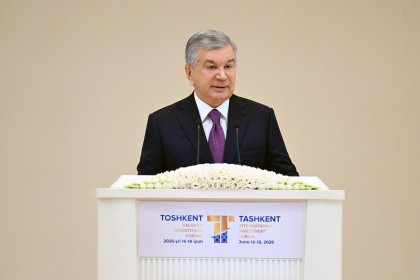
Зlenary session of the Foreign Investors' Council took place today at the International Congress Center, chaired by President Shavkat Mirziyoyev.
The event was attended by Odile Renaud-Basso, President of the European Bank for Reconstruction and Development, as well as the heads of leading international companies, banks, and financial institutions, along with representatives of prominent international organizations and bodies representing investor councils across Central Asia and the Caucasus.
Speaking at the session, the President Shavkat Mirziyoyev noted that over recent years, the Presidential Council has strengthened its standing as a vital platform for practical reform and dialogue between the government and the international business community.
Having been granted the status of an independent Association, it now brings together 85 companies spanning 23 sectors of the national economy. The Executive Committee includes the European Bank for Reconstruction and Development, the Asian Development Bank, and the International Finance Corporation.
The practical outcome of this cooperation has been the steady improvement of the regulatory and legal framework. Drawing on proposals put forward by Council members, amendments have been made to the Tax Code, certain financial regulation and reporting procedures have been simplified, and a number of mandatory requirements have been lifted for foreign companies that apply international financial reporting standards.
Work is also continuing to further align national legislation with international best practices. A draft law on Alternative Investment Funds has been prepared, a program for implementing responsible business conduct standards has been developed, and technical regulations are being harmonized with international requirements.
In addition, Uzbekistan has begun the process of acceding to the OECD Declaration on International Investment and Multinational Enterprises. The next step will be the adoption of a constitutional law on the Tashkent International Financial Centre.
The work of the Council's specialized working groups has taken on a systematic character. Over the period under review, more than 50 meetings have been held on topics including financial market development, improvements to collateral legislation, responsible business conduct, tax administration, energy, land administration, professional training, and other areas of mutual interest to the government and investors.
Preparations for the current session made it possible to put together a new package of initiatives from international partners.
The 120 proposals received have been consolidated into seven priority areas, covering improvements to the investment climate, tax and cadastral systems, the banking and financial sector, corporate governance, and energy, as well as the development of artificial intelligence and the digital economy.
Particular attention has been given to proposals for the further liberalization of currency regulation, the introduction of modern financial instruments — including Islamic insurance and green lending mechanisms — the development of the banking asset market, and the broader application of environmental, social, and corporate governance (ESG) principles.
Practical solutions have been developed for each of these areas, and responsible parties have been designated.
The President noted that the Council continues to serve as an effective forum for open dialogue, where business initiatives are translated into concrete government policy.
In this context, he emphasized the importance of maintaining direct engagement with international investors and continuing to improve feedback mechanisms.
As a result of the session, instructions were issued to consolidate all proposals into a unified "roadmap," with clear implementation timelines and oversight mechanisms defined.
It was specified that members of the Uzbek government responsible for the investment portfolio will report to the President on a quarterly basis regarding progress in carrying out the roadmap.
Participants in the session reaffirmed their interest in further expanding mutually beneficial cooperation and advancing joint initiatives aimed at strengthening Uzbekistan's investment appeal, ensuring sustainable economic growth, and continuing the reform agenda in the New Uzbekistan.
The plenary session was followed by thematic presentations, remarks from participants, and a question-and-answer session with Council members.