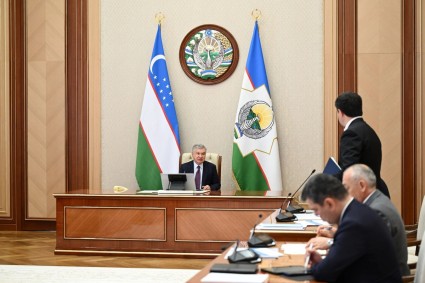
President Shavkat Mirziyoyev reviewed a presentation detailing plans to develop Uzbekistan’s critical mineral resource base and expand the production of high-value-added goods Monday.
According to government assessments, Uzbekistan possesses immense potential in this sector. However, the operations of the Uzbek Technological Metals Plant, founded in 2024, are currently limited primarily to the production of tungsten and molybdenum.
Opportunities exist to launch the industrial production of 28 types of critical minerals. This can be achieved by developing new deposits and constructing processing plants, alongside hydrometallurgical and pyrometallurgical facilities.
The presentation outlined strategic plans to tap into this potential between 2026 and 2030. During this period, the government aims to implement 120 projects worth a combined $4.2 billion. These initiatives are projected to boost the industry’s output to $1 billion by 2028 and to $2 billion by 2030.
For the current year, 12 projects valued at $166 million are slated for launch. These efforts are expected to introduce the production of three new metals—high-purity selenium, tellurium, and rhenium—as well as 21 types of import-substituting goods, including automotive components manufactured through powder metallurgy and sulfur-based processes.
Special emphasis was placed on processing tungsten and molybdenum to establish a complete "raw material–processing–finished product" value chain.
This strategy marks a shift away from exporting concentrates and semi-finished goods, moving instead toward manufacturing high-value-added products such as metal powders, alloys, rods, wires, and industrial components.
To achieve this, the government plans to launch the "Metals of the Future" technopark and an R&D center in Chirchik, with similar technoparks also slated for the Nurabad district of the Samarkand province and the Okhangaron district of the Tashkent province. These hubs will be designed to foster the commercialization of scientific research, support startups, and manufacture high-purity metals and innovative products.
The presentation also addressed the establishment of a specialized Research and Technological Center for Critical Minerals in Chirchik. According to the president’s press service, this facility will be the only center of its kind in Central Asia.
Additionally, a nanoanalysis laboratory is being set up in Chirchik to provide state-of-the-art analytical services for projects across geology, mining, and metallurgy. Once fully operational, the laboratory will be capable of analyzing up to 1,000 samples per day. This domestic capability is expected to substitute $6.5 million worth of imported services while generating an additional $4 million through service exports.
In an interview with the Uzbekistan 24 TV channel, the Chairman of Uzbek Technological Metals Combination Farkhod Abdullaev, noted that the emerging scientific and technological infrastructure will feature nanolabs, testing complexes, and technology commercialization centers.
"We are actively collaborating with companies from the United States, Europe, South Korea, and China on technology transfers, financing, and joint ventures to integrate into global supply chains," Abdullaev said. "The primary objective of the Technological Metals Combination is to secure the nation's technological independence, expand the production of high-value-added goods, and strengthen our position in the global critical minerals market. This strategy also lays the groundwork for broader industrial growth, higher export potential, and new job creation."
Stay up to date with all the latest news: