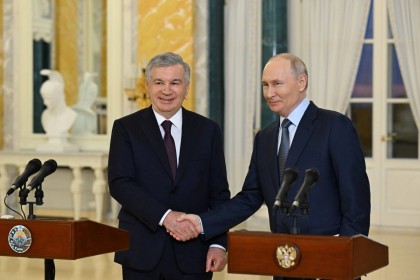
Russia will provide Uzbekistan with a concessional export loan to fund the construction of its nuclear power plant, the Russian President Vladimir Putin announced the financing on June 4 during a ceremony marking the start of Uzbekistan's first integrated nuclear power plant project.
The ceremony for pouring the "first concrete" of the future plant was held via a video link from St. Petersburg, with the participation of Uzbekistan's President Shavkat Mirziyoyev and Russian President Vladimir Putin.
"The start of pouring concrete into the foundation of power unit No. 1 means that the work to establish one of the largest nuclear power plants in the region is transitioning into practical reality," the Russian President stated.
He emphasized that the partnership is "mutually beneficial" and contributes to "the prosperity and well-being of the countries and peoples of both nations."
Putin revealed that the Russian state corporation Rosatom will construct two large Generation 3+ reactors in the Jizzakh region, each with a capacity of 1,000 MW, alongside two small power units of 55 MW each.
"This unique configuration, chosen by the President of Uzbekistan, has no global equivalent and will allow the nuclear power plant to operate at maximum capacity and efficiency," he said.
According to Vladimir Putin, once operational, the plant will generate approximately 17 billion kWh of electricity annually, meeting up to 15% of Uzbekistan's total energy consumption.
"This will be a tangible contribution to strengthening the energy security of the republic and, indeed, the entire Central Asian region as a whole," the Russian President concluded.
He noted that advanced technologies and modern engineering solutions will be utilized throughout the construction of the nuclear power plant.
The Russian President also stated that the project will generate substantial contracts for Uzbek enterprises.
"New jobs will be created, and local contractors will be actively involved in installation work, material supply, logistics, and other essential services. In total, approximately 15,000 people are expected to be employed directly at the construction site," Vladimir Putin noted.
He confirmed that Russia will not only construct the plant but will also extend a concessional export loan to Uzbekistan.
"Crucially, Russia will not just build the plant; we will also provide our partners in Uzbekistan with a concessional export loan and offer comprehensive lifecycle support for the facility's operations," the Russian President said.
According to Putin, this long-term support includes "commitments for the long-term supply of reactor fuel, ongoing technical and maintenance services, and the safe management of spent nuclear material."
Furthermore, Vladimir Putin stated that a full-fledged national nuclear industry is being established in Uzbekistan with Russian assistance.
"I have learned that Uzbekistan actually possesses an existing foundation, valuable experience, and a scientific base in this field. However, this infrastructure naturally requires modernization, as unfortunately, this sector did not receive the necessary attention in Uzbekistan over the preceding decades," he stated.
The Russian President added that Rosatom will transfer peaceful nuclear technologies directly to Uzbekistan.
"At the same time, Rosatom will transfer unique, peaceful nuclear technologies to our Uzbek partners. These applications extend far beyond energy, offering valuable tools for agriculture, medicine, and various other vital industries," he said.
Russia will also continue to support workforce development for the future plant. According to Putin, around 400 Uzbek citizens are currently studying nuclear energy-related disciplines at Russian universities. In addition, more than 300 students are enrolled at the Tashkent branch of the Moscow Engineering Physics Institute (MEPhI).
"The President of Uzbekistan looked far ahead, taking early steps to ensure the necessary conditions are in place to train a highly skilled national workforce," Putin concluded.