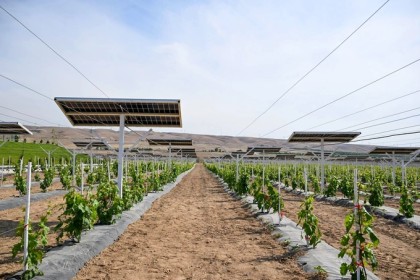
President Shavkat Mirziyoyev chaired a government meeting to outline measures for expanding high-yield, industrialized orchards across the country's provinces Thursday.
During the session, it was noted that Uzbekistan currently cultivates 572,600 hectares of orchards and vineyards. These lands generate $1 billion in annual exports and serve as a vital source of income for 882,000 citizens.
However, officials emphasized that amid increasingly scarce land and water resources, growth cannot rely on simply expanding acreage. Instead, the focus must shift to maximizing yield and revenue per hectare. As part of its long-term strategy, Uzbekistan aims to boost food exports to $10 billion by 2030, a goal where modern, industrialized horticulture will play a decisive role.
The president also stressed the need to digitalize land-use monitoring. To this end, he ordered the launch of a dedicated satellite imaging system to track the condition of both aging plots and newly developed industrial orchards.
To finance and support these initiatives, nine commercial banks will be assigned to specific regions. Beyond delivering ready-to-operate industrial orchards to entrepreneurs, these banks will provide agronomic, financial, and logistical oversight for a period of two years.
The meeting also outlined a specialized support framework for businesses looking to establish high-yield orchards. Local Agrostar companies will form joint ventures with entrepreneurs. Under this model, "Agrostar" will contribute up to 50% of the venture's equity in cash, while the entrepreneur will secure their stake using their land lease rights.
During the session, the president listened to feedback from participating business owners. He approved their proposals to introduce a zero-rate Value Added Tax (VAT) on both locally grown and imported fruit seedlings and rootstocks. Additionally, for industrial orchards utilizing water-saving technologies, the tax rate on well water extraction will be slashed to a symbolic 1 soum for a period of five years.
Officials were instructed to phase out aging, low-yield orchards and map out concrete pipelines for new industrial facilities. They were also tasked with institutionalizing cooperation between banks, local governments, and entrepreneurs, while expanding export-oriented crop varieties, agrologistics, and processing capacities in every region.
Stay up to date with all the latest news: