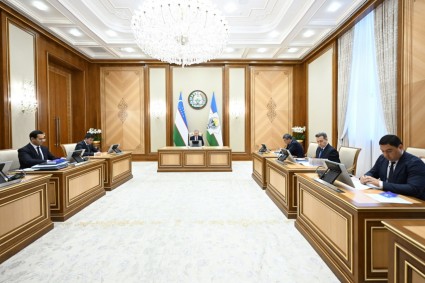
The president today Shavkat Mirziyoyev recently reviewed a presentation outlining new measures to slash red tape in governmental services.
In recent years, Uzbekistan has made significant strides in making government services more accessible, efficient, and transparent for both citizens and businesses. The volume of governmental services has grown tenfold, exceeding 61 million instances, with 80% now delivered online. In 2025 alone, more than 2,000 mandatory business regulations were scrapped.
Despite this progress, the system is still weighed down by redundant procedures, excessive paperwork, and overlapping requirements. Currently, government agencies manage 5,650 distinct functions and enforce over 42,000 business regulations across 1,041 available governmental services.
"Such a high volume of functions and requirements risks making the system inefficient, expensive, and at times, unfair. The only way forward is through deregulation, digitalization, and simplification," the president noted.
To transform Uzbekistan into a bureaucracy-free zone by 2030, the government has launched the "Zero Bureaucracy – 2030" program in partnership with the United Arab Emirates. A dedicated project office has been established under the Strategic Development and Reforms Agency to lead this effort.
The program aims to cut government functions by 30%, optimize 20% of business regulations, and push the share of digital governmental services past 90%.
The presentation detailed proposals to overhaul the governmental service system based on a "Service State" model. The core objective is to provide fast, transparent, and user-friendly services without requiring a single unnecessary document.
Key proposals include deploying a Zero Bureaucracy principle across 783 types of services. This move will transition 550 services to a digital-only format and cut the steps required to access them in half. Additionally, 80 services will become "proactive and composite," meaning the government will anticipate needs and group related tasks together. These changes are expected to save the public up to 35 billion soums annually in travel costs alone.
Wait times for another 80 services will be slashed by two to three times, dropping from an average of 13 days to just 6. Ten services will be fully automated, and fee reductions for 25 others are projected to save citizens approximately 851 billion soums every year.
Ten governmental services are slated for transfer to the private sector, while 15 types of certificates and documents will be digitized. This initiative will eliminate the need for redundant information requests across more than 270 different services.
Special attention is being paid to overhauling mandatory requirements. For instance, more than 500 disparate requirements currently apply to 20 documents related to market activities. Consolidating and systematizing these rules is expected to streamline over 30 percent of current requirements.
The reforms also highlight the potential for generating sanitary compliance certificates and medical examination lists electronically. This shift alone is projected to save 1 billion soums in budget funds annually and free up 24,000 man-hours for frontline operational tasks.
According to official estimates, reducing the administrative burden will deliver a direct economic boost of $1.5 billion per year. Improving regulatory quality is expected to attract an additional $800 million in foreign investment, while simplifying state-business interactions will increase labor productivity by $750 million annually. Overall, these anti-bureaucracy measures are projected to expand the national economy by an additional $13 billion between 2026 and 2030.
During the presentation, officials proposed hosting registries for government functions, mandatory requirements, and governmental services on a single platform, reestr.gov.uz. Other proposals included assessing agency performance via a Bureaucracy Radar system, utilizing AI for analysis, and implementing a Business Calculator to help entrepreneurs estimate compliance costs.
The president emphasized that governmental services are directly linked to protecting human interests, creating a favorable business climate, and ensuring effective governance. He stressed that every ministry and agency must re-evaluate its functions, eliminate redundant requirements, and accelerate the digitalization of its services.
Relevant officials have been tasked with drafting a resolution to dismantle bureaucracy. The document will outline specific digitalization plans for each ministry, streamline governmental services, and increase private sector involvement. Furthermore, instructions were issued to scale successful practices and consistently implement a Zero Bureaucracy principle across all government bodies.