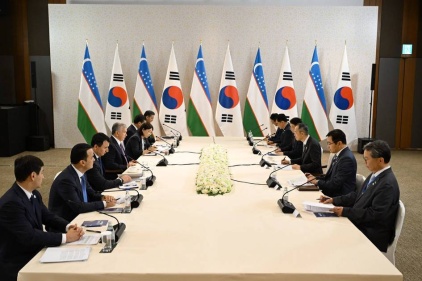
Uzbekistan is set to issue a new decree regarding the long-term leasing of agricultural land and the refinement of its allocation mechanisms. These plans were discussed during a presentation to President Shavkat Mirziyoyev on Tuesday.
Over the past five years, Uzbekistan has undergone systematic land reform. Notably, the power of provincial governors to distribute land was revoked, and all land allocation was transitioned to a transparent auction-based system. To date, 616,300 hectares have been distributed via auction, generating 1.4 trillion soums for the national budget.
"Most importantly, now that the land has true owners, income per hectare has tripled, reaching 50–60 million soums," the report noted. Currently, these lands produce 539 trillion soums worth of products annually, with exports reaching $2.1 billion.
The practice of allowing lessees to choose their own crops has already yielded positive results. In 2025, entrepreneurs across several regions planted high-yield, export-oriented crops of their choice on 16,000 out of 20,000 hectares, laying the groundwork for $150 million in projected exports.
To foster the development of industrial plantations and livestock farming, authorities have proposed auctioning land plots ranging from 50 to 500 hectares. At least five major projects are slated to launch in every region across the country within this year.
To support these initiatives, a comprehensive aid package has been introduced. This includes covering utility costs for water and electricity, providing low-interest loans for up to seven years (with a three-year grace period), offering interest rate subsidies, and reimbursing up to 50% of packaging costs.
In an interview with the Uzbekistan 24 TV channel, Ilhom Norkulov, First Deputy Minister of Economy and Finance, recalled that 20,000 hectares were leased out last year in 50-hectare blocks for 49-year terms. "This reform has been a success," he noted.
Under the proposed new system, the government aims to expand long-term leasing while granting tenants significantly more autonomy.
"Now, under a unified framework—including Presidential Decree No. 18—we plan to offer agricultural land for 49-year leases with the right to choose crops freely, with a strategic focus on attracting professional investors," the First Deputy Minister stated.
New approaches to land sales are also being considered. Specifically, a proposal has been put forward allowing provincial governors (hokims) to initiate the auctioning of plots up to 500 hectares for the development of industrial plantations.
"Under this plan, we propose selling irrigated land at a starting price of up to 50% of its normative value. If a plot fails to sell, the starting price can be gradually reduced by 10% increments—potentially dropping as low as 10% of the original valuation," Norkulov explained.
For pasture lands, the proposal is even more aggressive, with starting auction prices suggested at just 1% of their appraised value.
"Overall, these new approaches are designed to identify efficient managers and get land into the hands of professional investors," Ilhom Norkulov emphasized.
It is worth noting that by 2027, all agricultural land in Uzbekistan must transition to leasehold agreements. While all such land has been issued exclusively through leases since 2021, a portion is still being utilized under legacy terms.
Furthermore, a presidential decree dated September 12, 2025, granted agricultural tenants the right to sublease portions of their plots to other users. This document also reinforces that leasing is the only recognized form of agricultural land tenure; other forms of ownership are no longer eligible for registration, with only a few specific exceptions.