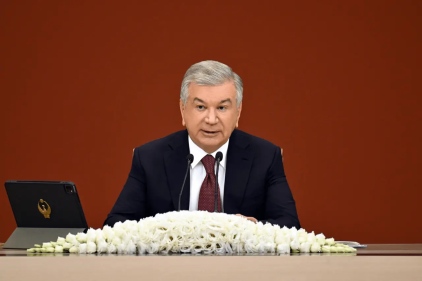
Afghanistan will not begin full-scale water withdrawals from the Amu Darya through the Qosh Tepa canal before 2030, the Water Resources Minister Shavkat Khamraev said today, Nov. 19.
Speaking to journalists, Khamraev said construction of the canal is continuing and that withdrawals would be agreed only once it is finished. “They will start taking water when construction is finished. Maybe even in 2050. But they definitely won’t start before 2030,” he said.
He said the canal has not yet taken any water and rejected a suggestion that a drop in Amu Darya inflows to Uzbekistan in some months was linked to it. “Qosh Tepa has not taken a single bucket of water so far,” he said.
Khamraev said Afghanistan has the right to use Amu Darya water but that volumes and other terms remain to be agreed. He said the two sides have an understanding to sign agreements on withdrawal volumes after construction ends. An Afghan delegation led by the deputy minister of agriculture visited Uzbekistan last week, he said.
Afghanistan has said it would take about 10 billion cubic meters of water in a high-water year and 6 billion in a low-water year, the minister said. He called these rough calculations and said they would be acceptable. Amu Darya flow can vary from about 50 billion to 100 billion cubic meters a year, he said, so volumes should reflect the river’s actual water level.
Estimates suggest the canal could carry 450–500 cubic meters per second, and Afghanistan hopes to irrigate 500,000–600,000 hectares, Khamraev said. By gravity, water could reach only 200,000–250,000 hectares, and the rest would require pumping, he said, adding that Afghanistan lacks the capacity to run such infrastructure at that scale.
He said the canal should be a source of cooperation rather than conflict. “Thanks to this dialogue, Qosh Tepa should become not a canal that drives us apart, but a canal of friendship and brotherhood,” he said.
Construction of the roughly 285-km canal in northern Afghanistan began in 2022. It is planned to irrigate farmland in Balkh, Jawzjan and Faryab provinces. A first section of about 108 km was completed in October 2023, and work on the next section and on hydraulic structures continued in 2026.
In March 2026, Khamraev said an Afghan withdrawal of 2 billion cubic meters a year would not create critical problems for Uzbekistan, but that 4 billion could seriously threaten agriculture. On Nov. 19 he did not say how calculations of the canal’s impact have changed.
In October 2026, the Institute for Advanced International Studies at the University of World Economy and Diplomacy said reliable public data on the canal’s actual withdrawals and operations remain scarce.