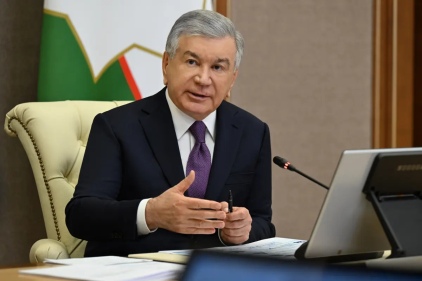
At today's meeting with investors and business owners from the transport and logistics sector, President Shavkat Mirziyoyev stressed that Uzbekistan has every opportunity to become a major land port linking East with West and North with South.
Middle Corridor potential still not fully used
Officials were instructed to finalize agreements with Azerbaijan, Turkmenistan and Georgia on mutual recognition of electronic cargo documents.
They were also tasked with launching block train services from Uzbekistan to ports on the Caspian, Black and East China seas and in the Baltic states, and informing entrepreneurs about them.
Freight wagon imports to be exempt from VAT
Demand for freight wagons is rising every year, and it was stressed that the fleet needs to grow by 5,000 to 6,000 wagons annually.
To support this, entrepreneurs will receive several benefits:
- freight wagon imports will be exempt from value-added tax (VAT);
- a discount of up to 20% will apply to fees for using railway lines;
- a zero VAT rate will apply to the provision of domestic wagons for international freight.
New railway tariff policy
The president said a new tariff policy for the railway sector had been developed with the World Bank. Officials were instructed to begin phasing it in from 2027.
From next year, they are also to implement a system that, for each route, shows separately the charges for railway line use, locomotives and wagons.
Bus and metro services
Over the past three years, entrepreneurs have brought in more than 3,500 modern buses, and 330 routes have moved to a new system. As a result, daily passenger numbers have doubled in the capital and risen 2.5 times in the provinces.
All bus routes of up to 20 kilometers linking the capital with its metropolitan area will now be switched fully to the "gross-cost" contract system.
Entrepreneurs who build bus depots for at least 100 vehicles will be able to deduct construction costs from their tax base.
Officials were given one month to develop a new financing mechanism, similar to the gross-cost system, that would make bus routes linking remote areas with cities attractive to entrepreneurs.
The metro currently carries 46% of passengers in the capital. Daily ridership has grown 25% and is expected to reach 1.3 million by the end of the year. However, crowding at stations and queues to board trains were noted.
Metro rolling stock will continue to be renewed, with 28 five-car trains to arrive over the next two years. In addition, 40 four-car trains now in service will be expanded to five cars.
Railway infrastructure
Plans were outlined to develop railway infrastructure and expand international transport corridors.
With the launch of the China–Kyrgyzstan–Uzbekistan railway, freight volume on this route is expected to increase tenfold to 15 million to 16 million tons a year. The president stressed that the national rail network must be developed accordingly.
Currently, 25% of the country's railways operate at full capacity and another 15% are overloaded.
By 2030, the plan is to build 545 kilometers of new lines, raise the share of electrified track to 65% and expand the electric train fleet to 31.
Plans for 2027 include:
- modernizing the Angren–Pap line and considering a second line on this route;
- starting construction in April of a second Tukimachi–Angren track;
- completing modernization of sections between Tashguzar and Kumkurgan;
- fully electrifying the Andijan–Khanabad and Kumkurgan–Kudukli lines;
- beginning construction of a separate Tashkent–Samarkand high-speed line.
The president invited international financial institutions and investors to take part in these projects, estimated to cost a total of $8 billion.
Aviation
From 2027, jet fuel prices will be linked to average world prices. The fuel will be exempt from excise tax and subject to a zero VAT rate.
Other support for airlines includes:
- extending customs duty relief on spare parts until 2040;
- applying zero VAT to leases of aircraft, engines and components;
- implementing one-day VAT refunds on imported spare parts.
Airlines that commit to training and employing local pilots will receive additional benefits. The social tax rate for foreign specialists they hire will be 1%, and the fee for these specialists' permits will be cut thirtyfold.
These measures are intended to expand Uzbekistan's aircraft fleet to 150 in 2027 and at least 250 by 2030.
Air passenger traffic is expected to reach 17 million in 2026, with plans to raise it to 25 million in the coming years.
The president also proposed establishing the International Civil Aviation University of Uzbekistan. It would receive 20 hectares in New Tashkent for a modern campus and training, simulator and research centers.
The mechanism for linking fuel prices to world quotations, the price indicators to be used and the frequency of price reviews have not yet been specified.