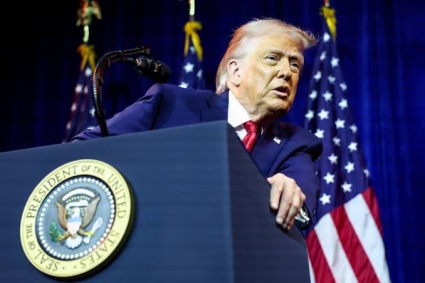
Democrats have won control of both chambers of the US Congress in a sweeping victory in Tuesday's midterm elections, delivering a major political setback to President Donald Trump and significantly narrowing his room for manoeuvre during the final two years of his presidency.
The results mark a dramatic reversal of Republican fortunes, with Democrats making substantial gains not only in traditionally competitive states but also in Republican strongholds, including Texas, Kansas, Iowa and South Carolina. The victories give Democrats control of the House of Representatives and the Senate for the first time during Trump's second term, ushering in a period of divided government in Washington.
The scale of the Republican defeat suggests that the election became a referendum on Trump's presidency, with voters expressing growing dissatisfaction over the economy, rising living costs, the administration's policies and the war with Iran.
According to exit polls conducted by SSRS for a consortium of US media organisations, including major television networks and the Associated Press, approximately half of voters said they viewed the midterms as an opportunity to rebuke Trump. Around three-quarters described themselves as angry or dissatisfied with the direction of the country, while 70% said they wanted Congress to exercise stronger checks and balances on the president.
CBS News' separate exit polling put Trump's approval rating at approximately 38%, the lowest recorded for a president in a midterm election in recent decades. Nearly nine in 10 voters identified the cost of living as a major or crucial factor in their voting decisions, while nearly two-thirds blamed Trump for high prices.
The economy emerged as the most important issue for voters overall, followed by concerns about the state of democracy. Government corruption was also a major concern, with roughly nine in 10 voters identifying it as an important factor in their decision.
The findings point to a combination of economic dissatisfaction and opposition to Trump's leadership as key factors behind the Democratic gains.
A political map reshaped
Democrats scored several historic victories, breaking through in states where Republicans had enjoyed longstanding electoral advantages.
In Texas, Democrat James Talarico won a Senate seat, ending a decades-long losing streak for the party in statewide Senate elections. Democrat Gina Hinojosa also defeated three-term Republican Governor Greg Abbott, becoming the state's first Latina governor.
In Kansas, Democrat Adam Hamilton defeated Republican incumbent Roger Marshall, marking the first Democratic Senate victory in the state since 1932. Democrats also captured a Senate seat in South Carolina, where Annie Andrews defeated Trump's preferred candidate, Darline Graham.
In Ohio, former Democratic Senator Sherrod Brown reclaimed a Republican-held Senate seat, while Democrats also secured victories in Iowa, North Carolina and Maine.
The results extended beyond congressional contests. Democrat Keisha Lance Bottoms won Georgia's gubernatorial race, becoming the first Black woman elected governor of a US state.
The Associated Press reported that Democrats won all 20 closely watched House races decided at the time of its reporting, while largely resisting Republican efforts to redraw congressional districts to improve the party's electoral prospects.
The Democratic gains also reflected changes in voter behaviour. AP VoteCast data indicated a significant shift among younger voters, with approximately seven in 10 voters under 30 supporting Democratic House candidates. Republicans also lost ground among Black men and Hispanic voters compared with the coalition that helped Trump win the 2024 presidential election.
Trump's room for manoeuvre narrows
The immediate consequence of the Democratic victory will be a fundamental change in the balance of power in Washington.
For the first two years of Trump's second presidency, Republican control of Congress allowed the White House to advance much of its legislative agenda with limited resistance from lawmakers of its own party. That political environment will change when the new Congress convenes in January.
With control of both chambers, Democrats will gain the chairmanships of congressional committees, control over legislative proceedings and greater authority to investigate the administration.
They are expected to intensify congressional scrutiny of Trump's policies, government spending, immigration enforcement, the administration's handling of the Iran war and allegations surrounding the financial interests of the president and his family.
Congressional committees will also have the power to summon administration officials, demand documents and issue subpoenas as part of investigations. Although the administration could challenge or resist some of these demands, the investigations would create sustained political and legal pressure on the White House.
Control of the Senate could prove particularly consequential. Democrats will be able to influence or block presidential nominations for senior government positions, federal judgeships and diplomatic posts. Any vacancy on the Supreme Court could also become a major political confrontation, as Democrats would have the power to withhold confirmation from Trump's nominees.
The change will also give Democrats greater leverage over federal spending, government funding and negotiations on the national debt ceiling, potentially setting the stage for confrontations over the budget and the possibility of government shutdowns.
Trump retains executive powers
Despite the scale of the defeat, the election does not strip Trump of his constitutional authority as president.
He retains the power to veto legislation, command the armed forces, direct foreign policy and exercise broad executive authority over areas such as immigration and trade. Overriding a presidential veto requires a two-thirds majority in both chambers, a threshold Democrats are unlikely to reach on their own.
Furthermore, most major legislation in the Senate requires 60 votes to overcome a filibuster, meaning that even with control of the chamber, Democrats will need Republican support for many legislative initiatives.
The new balance of power is therefore more likely to produce political confrontation, congressional investigations and legislative gridlock than an immediate reversal of Trump's policies.
Nevertheless, the Democratic majority will make it considerably harder for the president to govern without congressional scrutiny or negotiate legislation entirely on Republican terms.
The results could also complicate Trump's foreign policy. While the president retains substantial authority in international affairs, congressional control over funding, oversight and certain legislative authorisations gives Democrats additional instruments to question and challenge the administration's decisions, including its approach to Iran.
A warning ahead of 2028
The election also raises questions about the future of the Republican Party and Trump's political influence as attention increasingly turns towards the 2028 presidential race.
Trump personally intervened in numerous Republican primaries and urged supporters to treat the midterms as a referendum on his presidency. The scale of the losses could intensify criticism within the party over his political strategy, candidate selections and continued dominance over Republican politics.
For Democrats, however, the victory brings its own challenges. Having campaigned heavily on the cost of living, government accountability and opposition to Trump, the party will now face pressure to demonstrate that congressional control can translate into tangible results.
Neither party enjoys overwhelming public support, and the election does not necessarily represent a broad endorsement of the Democratic political programme. Rather, the exit polls suggest that dissatisfaction with the administration and a desire for stronger congressional oversight were central motivations for many voters.
The next two years are therefore likely to be marked by an increasingly contentious relationship between the White House and Congress, with investigations, budget disputes, confirmation battles and disagreements over domestic and foreign policy shaping the political agenda.
For Trump, the midterm results represent more than the loss of a congressional majority. They remove the unified Republican control that had provided him with considerable legislative latitude and place much of the remainder of his presidency under the scrutiny of an opposition-controlled Congress.