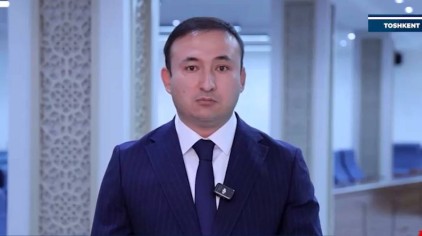
Uzbekistan is working toward eliminating poverty entirely by 2030, Farrukh Toshpulatov, an official at the Ministry of Employment, told the Renaissance television channel this week — a target officials say is now within reach after the country's original goal was met years ahead of schedule.
According to Toshpulatov, the original plan had been to halve the poverty rate over four years as part of Uzbekistan's national commitments under the U.N.'s Sustainable Development Goals. That target, he said, was reached in 2025 — a year early.
"Halving the poverty rate by 2030 was one of the national targets Uzbekistan set as part of the U.N.'s Sustainable Development Goals. We achieved that target back in 2025. Now, the main goal is to eliminate poverty in Uzbekistan entirely by 2030," he said.
Toshpulatov stressed that significant work is underway to create stable jobs and income sources for low-income families, noting that over the past eight years, 700,000 entrepreneurs have established stable businesses of their own.
"As a result of our efforts to support the population's business initiatives, one million microprojects were launched over the past four years, creating 1.8 million jobs. In addition, 250,000 hectares of land were allocated on a leasehold basis to 800,000 people as an income-generating asset. Through this, we are introducing a 'one cluster, one product' approach to agricultural production," the official said.
At an event marking the 35th anniversary of Uzbekistan's independence, officials announced that the country's poverty rate had fallen from 35% in 2017 to just 4% today.
A debate over the yardstick
The government's poverty figures rest on a specific benchmark: the "minimum consumption expenditure" indicator, which Uzbekistan's National Statistics Committee revises annually and uses to draw the official poverty line. For 2026, that threshold was set at 715,000 soums per person per month — roughly $57 — up from 669,000 soums, or about $51, in 2025.
The mechanics of the measurement matter here. Because the government itself sets the minimum consumption expenditure figure each year, it effectively determines where the poverty line falls — and therefore what share of the population counts as poor. A lower threshold mathematically produces a lower poverty rate, regardless of how much household living standards have actually changed.
Critics argue this gives authorities latitude to engineer improving statistics simply by holding the line low, rather than through income gains alone — a dynamic they say is already visible in a threshold set at roughly $57 a month, a figure well below what many economists consider sufficient to cover basic needs. On this view, a declared goal of "eliminating poverty" by 2030 is at least partly a function of how conservatively the line itself is drawn, not solely a measure of how much has changed for the households it's meant to describe.
The World Bank, while crediting Uzbekistan's reforms for real gains, has also flagged that inequality has been rising alongside the official poverty decline, with incomes for the wealthiest households growing far faster than for the poorest — a dynamic that headline poverty figures alone do not capture.
Stay up to date with all the latest news: