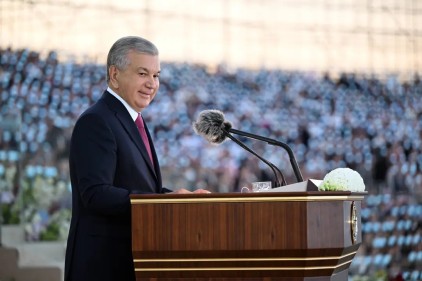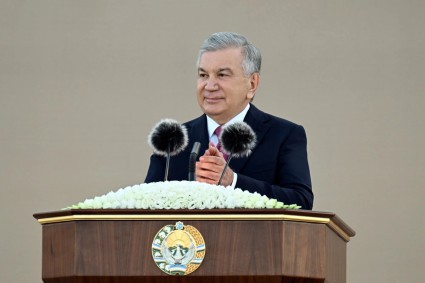
President Shavkat Mirziyoyev delivered a speech in Tashkent on Friday, Aug. 28 at a ceremony marking the 35th anniversary of Uzbekistan's independence.
Shavkat Mirziyoyev said the country now stands at a more consequential and decisive juncture in its history, entering an entirely new phase of development.
"The coming decade will be a period of national ascent for us," Mirziyoyev said, adding that this era can only be built through the intellect, labor and unity of the Uzbek people.
To that end, he announced that seven national programs designed to further elevate human dignity will be rolled out in the coming years.
The first program aims to make knowledge and skills the primary capital driving future growth. Enrollment of six-year-olds in preparatory school groups will be raised to 100 percent in the near term, while existing incentives for opening private kindergartens will remain in place.
The second program is intended to safeguard public health and extend life expectancy. State spending on healthcare will rise to 5 percent of gross domestic product over the next five years.
"The third national program is to shift our economy toward a model built on advanced technology and labor productivity," the president said, noting that $450 billion in foreign investment will be attracted over the next decade to support this shift.
The fourth program seeks to fundamentally overhaul the country's approach to water and natural resources. Water-saving technologies will be extended to 100 percent of cultivated farmland within five years.
The fifth program is focused on reinforcing judicial independence and embedding the rule of law as a shared national value. Legal education will be deployed systematically starting in schools, and reforms strengthening the legal protections afforded to citizens and entrepreneurs will continue.
The sixth program is aimed at making the mahalla — Uzbekistan's traditional neighborhood community structure — the central driver of local development. "The whole approach to designing state programs is now going to change," the president said, explaining that district budgets, investment plans and infrastructure projects will henceforth be built around mahalla-level requests, with residents' needs and community welfare serving as the primary benchmark.
The seventh program is intended to comprehensively strengthen Uzbekistan's standing as a land of peace, friendship and tolerance. "In today's turbulent times, interethnic harmony and religious tolerance are our people's golden asset and most precious wealth," the president said.