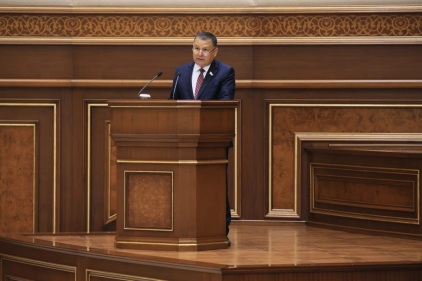
Construction has begun on a new toll highway between Tashkent and Samarkand, valued at nearly $2.2 billion. Once operational, the road will cut travel time between the two cities from 5 hours to 2.5 hours, President Shavkat Mirziyoyev announced.
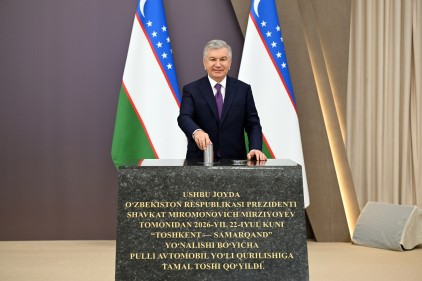
Shavkat Mirziyoyev today took part in a groundbreaking ceremony for the highway in the Urtachirchik district of Tashkent province.
The six-lane highway will run 282 kilometers in total. The project calls for building 92 bridges, 28 overpasses, and 60 tunnel crossings.
The road will be paved with monolithic concrete designed to withstand heavy and high-speed traffic. On flat stretches, vehicles will be able to travel at speeds of up to 150 km/h.
Modern safety systems and digital solutions are expected to significantly reduce the number of traffic accidents.
Once operational, the highway's capacity will range from 60,000 to 80,000 vehicles per day, and freight transport costs are expected to drop by 20-24%.
Shavkat Mirziyoyev called the highway's construction "another major historic step" in developing Uzbekistan's transport infrastructure, declaring that "a truly new era" is beginning in the country's road sector.
The new route is expected to boost economic activity in the provinces it passes through. Citing World Bank analysis, the president noted that every dollar invested in this kind of infrastructure project can generate up to five dollars in economic returns.
The highway is projected to increase the gross provinceal product of Tashkent, Syrdarya, Jizzakh, and Samarkand provinces by 3%. Across 13 districts with a combined population of more than 2 million people, the project is expected to create thousands of jobs and new sources of income.
Plans call for logistics centers, warehouses, industrial and agro-industrial enterprises, retail and service facilities, hotels, and tourism complexes to be built along the route. Officials noted that relying on local services and construction materials will provide entrepreneurs with major contracts and help build new production capacity.
Shavkat Mirziyoyev also announced that construction has begun on the Khiva-Urgench road, that the international tender for the Tashkent-Andijan route is nearing completion, and that design work on the Tashkent-Bostanlyk road is in its final stage.
"Today, ahead of the 35th anniversary of our homeland's independence, we are laying yet another solid foundation for the country's future, its economic resilience, and the wellbeing of our people," the president said as he launched construction of the highway.
About the toll road
The new Tashkent-Samarkand toll road will begin at the Tashkent ring road in the Sergeli district. Authorities are considering a phased rollout, starting with the Tashkent-Syrdarya section.
Transport Minister Ilkhom Makhkamov had previously said construction of the Tashkent-Samarkand toll highway was planned to begin in July 2026. According to him, preparatory work had been completed, a contractor had been selected, and signing of the EPC contract was expected in June.
The project was estimated to cost $2.185 billion and was planned to be carried out in four phases. Chinese banks were to finance 85% of the cost, or $1.857 billion, with Uzbekistan's budget covering the remaining 15%, or $328 million. A one-year bridge loan of $200 million was also being considered to get construction underway.
The new six-lane highway will span 282 kilometers, linking Tashkent, Syrdarya, Jizzakh, and Samarkand provinces, with a design speed of up to 150 km/h. The government had previously considered launching the road in stages, beginning with the Tashkent-Syrdarya section.
The transport minister noted that the existing road already carries more traffic than it was designed to handle. The new highway is expected to cut travel time by a factor of 2 to 2.5.
Toll rates were to be determined following negotiations with investors, taking into account the public's financial means. The route will include interchanges, bridges, overpasses, tunnel crossings, terminals, roadside infrastructure facilities, an intelligent transport system, and weight control stations.
Stay up to date with all the latest news: