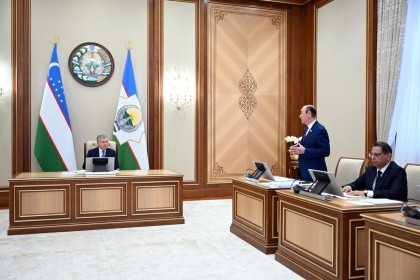
President Shavkat Mirziyoyev was briefed on a presentation detailing the expansion of the country’s transport infrastructure Tuesday. The session focused on reviewing the progress of large-scale investment projects within the transportation sector.
A major focus of the presentation was the construction project for the alternative "Tashkent–Samarkand" toll highway. Stretching 282 kilometers, this express route will link the Tashkent, Sirdaryo, Jizzakh, and Samarkand provinces. The highway will be built to Category I-a standards, featuring a durable cement-concrete surface and three traffic lanes in each direction. It is designed to support a legal travel speed of 150 kilometers per hour.
The scope of this infrastructure initiative encompasses 12 interchanges, 60 underpasses, 91 bridges, 16 overpasses, 258 drainage structures, and the integration of an Intelligent Transportation System (ITS). Additionally, the project will feature 12 terminal stations, comprehensive roadside amenities, and automated weigh-in-motion systems for freight vehicles.
The president directed officials to expedite negotiations with prospective international investors so that construction operations can begin without delay.
The presentation also reviewed blueprints for the construction of the New Tashkent International Airport. Built to support an annual capacity of 20 million passengers, the hub will feature a passenger terminal spanning 208,400 square meters. The complex will also include 169 aircraft parking bays and two runways, each stretching 4 kilometers in length.
To date, environmental and social impact assessments have been successfully completed in strict accordance with the requirements of international financial institutions. Ground operations to relocate canals, drainage collectors, and power grids within the project zone have already commenced. Simultaneously, active negotiations are underway with designated engineering and contracting firms.
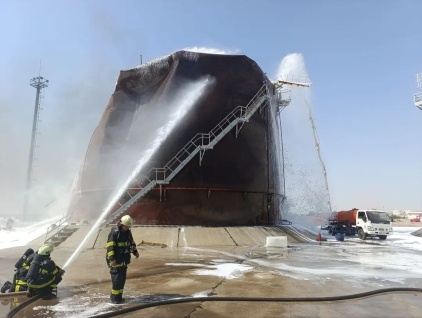
The current combined capacity of fueling complexes across the nation's airports stands at 49,000 tons. By 2030, the government plans to scale up domestic aviation fuel production to 600,000 tons per year, while expanding total jet fuel storage capacity to 80,000 tons. To achieve this milestone, brand-new storage facilities will be constructed at the Navoi, Andijan, Bukhara, Urgench, and New Tashkent international airports.
Attendees emphasized the necessity of gradually transitioning all fuel storage and aircraft refueling processes to international standards. The management operations of refueling complexes are slated to be fully digitalized within the current year, and a systematic framework for state oversight will be established to monitor compliance with strict technological protocols across all airport fueling operations.
The presentation also addressed fuel security and supply logistics for the civil aviation sector.
The president stressed that economic viability, construction quality, rigorous safety standards, and public convenience must serve as the primary benchmarks for transport infrastructure expansion, and he issued corresponding directives to the responsible authorities.
Stay up to date with all the latest news: