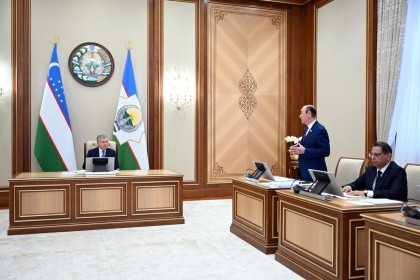
Efforts to elevate the caliber of academic training, boost the practical impact of research, reinforce the principles of academic integrity, and optimize governance within the sector were discussed during a presentation to President Shavkat Mirziyoyev on Monday.
According to the presidential press service, the following proposals were reviewed:
- Targeted Support for Critical Sectors: A new support framework will be introduced for researchers specializing in priority fields, including artificial intelligence, renewable energy, food security, medicine, water resource management, advanced materials, and seismology. Doctoral stipends in these disciplines are set to increase by 1.7 times, and researchers will receive additional annual funding to purchase vital scientific equipment and chemical reagents.
- Accountability and Incentives for Advisors: The plan aims to hold academic advisors more accountable while improving their financial incentives. A results-oriented bonus system will be established to reward advisors for successfully defended dissertations, taking into account their overall level of international scientific activity and publishing metrics.
- Overhaul of the Supreme Attestation Commission (SAC): The operational structure of the SAC will undergo a major transformation, transferring its governance from the Ministry of Higher Education to the Academy of Sciences. This move aims to expand the responsibilities of academic councils and introduce a merit-based rating system to evaluate their performance.
- Elimination of Bureaucracy Through Automation: Bureaucratic red tape will be cut by fully digitalizing the academic degree conferral process. Transitioning the dissertation defense process online is expected to reduce administrative turnaround times by 50%. Redundant requirements, such as printing excessive physical documents, producing massive volumes of dissertation abstracts, and undergoing repetitive thesis reviews, are slated for elimination.
The implementation of "Project-Based Degree" and "Applied Doctorate" programs will allow researchers to earn their PhDs directly through applied research initiatives. Under this framework, doctoral research topics must align with the practical needs of industry and the broader economy. These scientific inquiries will be conducted in close partnership with enterprises in the real sector, placing a heavy emphasis on translating research findings into tangible practical applications.
The funding and selection system for scientific projects will also undergo an overhaul. The plan involves bringing international experts into the evaluation process, introducing digital technology to assess project proposals, and maximizing transparency and efficiency in how research grants are distributed.
To keep pace with rapidly accelerating scientific activity, a unified digital system will be launched to monitor the academic output of researchers. This will be accompanied by updated standards for research ethics and robust quality control mechanisms for scientific studies.
Finally, to expand collaboration with Uzbek expatriate scientists working abroad, a proposal was made to establish a Scientific Advisory Council. This body will formulate strategic recommendations to advance the country's scientific sector based on international best practices, foster a stronger culture of academic research, and refine modern methodological standards.
Stay up to date with all the latest news: