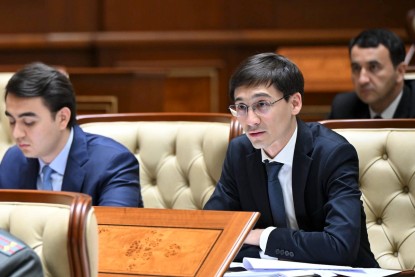
As part of its accession process to the BRICS New Development Bank (NDB), Uzbekistan has compiled a proposal portfolio consisting of over 20 projects valued at $4.5 billion. Shokhrukh Gulamov, the Acting Deputy Minister of Investments, Industry, and Trade, announced the plans during a Senate session on May 19.
Gulamov noted that amid shifting global dynamics and financial imbalances, the prudent and effective deployment of the bank's resources stands as a primary objective for Uzbekistan.
"In the energy sector, resources are projected to be funneled into nuclear power plant projects," Gulamov stated.
For urban development, Uzbekistan plans to draw on NDB funds to finance the foundational infrastructure for the "New Tashkent" mega-project.
Furthermore, the ministry official revealed that Uzbekistan has outlined nearly $450 million worth of projects dedicated to the social sphere, specifically targeting advancements in education and healthcare.
"We are also currently evaluating options to channel approximately $500 million of the bank's capital to support our domestic commercial banks," he added.
An additional $750 million is slated to be funneled into the industrial sector to support developing industrial and economic zones across the regions.
Discussing the operational frameworks with the bank, Shokhrukh Gulamov stated that engagement will be structured across three key pillars.
"The first is sovereign financing, which entails funding projects backed by state guarantees. The second is non-sovereign financing, meaning direct capital injections into the private sector. The third pillar is project financing rooted in public-private partnership (PPP) principles," he explained.
"In compliance with this regulatory mechanism and the aforementioned decree, we are currently working alongside relevant ministries and agencies to preemptively flesh out projects with the New Development Bank, design their concepts, and, where necessary, draft project appraisal documentation," the Acting Deputy Minister reported.
He further noted that securing technical assistance, specifically in the form of grants from the New Development Bank, is also high on the agenda.
During the session, senators formally approved the law on Uzbekistan's accession to the agreement establishing the New Development Bank—a multilateral financial institution founded by the BRICS nations. The bank specializes in financing infrastructure, green transition, digital development, and socially vital projects.
Cost and Financing of Small Nuclear Power Plant
In March 2025, Azim Ahmedkhadjaev, the chief of Uzatom, announced that the cost of the small nuclear power plant (SMR) in Uzbekistan would be under $2 billion. At that time, the plan detailed the construction of a station featuring six reactors with a combined capacity of 330 MW (55 MW each).
He stated then that the project would be funded through foreign direct investments and concessional loans from China, entirely bypassing Russian financial resources. The intent was to minimize the impact on the national state budget.
However, at the end of September last year, Uzbekistan and Russia signed agreements that restructured the layout of the future nuclear facility in the Farish district of the Jizzakh province. Instead of six small power blocks, the updated project introduces two small blocks alongside two large-scale 1 GW reactors.
By co-locating both a small and a large nuclear power plant at the same site, officials expect to achieve the "most cost-effective option in terms of megawatt-hour (MWh) output."
In October, Abdujamil Kalmuratov, Director of the NPP Construction Directorate, announced that the cost of the small nuclear project would not exceed $1 billion, with the final price tag to be locked into the contract. Crucially, he emphasized that construction would now be funded directly through the state budget.
"Yes, it is the state budget. The state is building this—this is an entirely Uzbekistani project. The funding source is our own budget. A nuclear project must be a national one," Kalmuratov declared.
Stay up to date with all the latest news: