The new high-speed rail line connecting Tashkent and Samarkand is planned to be extended all the way to Khiva in the future. If this strategic project is fully realized, travel time from the capital to the historic city of Khiva will be slashed from the current 7.5 hours down to just 5 hours.
"We have just finalized the design for the 300-kilometer Tashkent–Samarkand high-speed rail line. Travel time on this section will be just 1 hour and 40 minutes. Beyond that, construction must continue. Why shouldn't we extend it all the way to Khiva?" the Deputy Minister said during the 59th Annual Meeting of the Asian Development Bank Board of Governors held in Samarkand.
Despite the project's high complexity, its feasibility study was completed in record time—taking approximately 14 months. Under the initial timeline, this phase was scheduled to take 15 months and wrap up in March 2026.
The Ministry of Transport, in coordination with the World Bank, is currently onboarding additional consultants to validate the project and boost its investment appeal. Following this validation phase, an international tender will be officially launched.
According to Jasurbek Choriev, the Ministry of Transport aims to launch the railway construction work within this year. Sangjin Kang, Head of the Korea Export-Import Bank (Eximbank) office in Tashkent, noted that the high-speed line is scheduled for full commissioning in the first half of the 2030s, with the average construction phase projected to last between 7 and 10 years.
The technical parameters released by Sangjin Kang align with the first proposed route alternative. This variant features a total track length of 282 kilometers, a transit time of 1 hour and 26 minutes, and an average operating speed of 185.7 km/h. The infrastructure blueprint entails building 74 bridges spanning a combined length of 8.9 kilometers, alongside 3 tunnels.
Who Will Build the Railway?
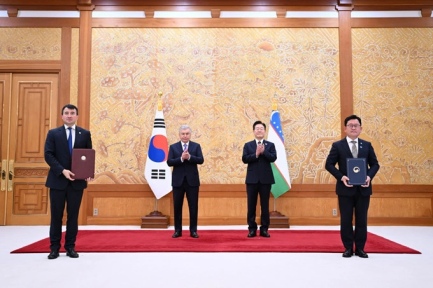
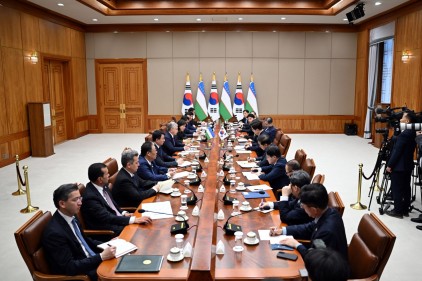
The final feasibility study for the new rail link was prepared by a consortium of South Korean firms, backed by a $3 million grant from Korea Eximbank. The consortium brings together several prestigious industry leaders, including:
- Saman Engineering
- Dong Myeong Engineering Consultants & Architecture Co., Ltd.
- Korea Railroad Corporation (KORAIL)
- Korea National Railway
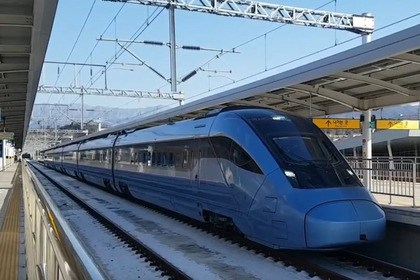
The project will also heavily leverage South Korean engineering for its rolling stock. Specifically, a high-speed Hyundai Rotem train from South Korea was deployed for trial runs between Tashkent and Khiva. The seven-carriage trainset can reach operational speeds of up to 260 km/h. Moving forward, the ministry plans to utilize this exact model on the newly constructed express line.