Between January and March, Uzbekistan’s natural gas production totaled 9.6 billion cubic meters (BCM), marking a 15% decline compared to the 11.3 BCM produced during the same period in 2025, the National Statistics Committee said in a report.
In March alone, production fell to 2.7 BCM - a significant 30.8% drop (1.2 BCM) compared to March 2025. Daily output also saw a sharp decline, plummeting from 125.8 million cubic meters (MCM) in March of last year to 87.1 MCM this March. By comparison, daily production in February 2026 averaged around 114 MCM.
Speaking at Energy Week in Tashkent on May 12, the Energy Minister Jurabek Mirzamakhmudov said that this downturn was expected.
"We have discussed this before; we are seeing a natural year-over-year decline. It was obvious that production volumes would drop—we’ve been transparent about that. Our primary goal now is to stabilize the situation and maintain current levels," the Minister explained.
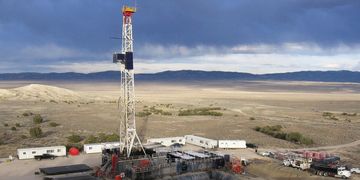
To achieve this, the Minister noted that the government is working with Uzbequeftgaz and other partners on drilling projects, equipment upgrades, geological exploration, and the development of new sites.
"Our collaboration with SOCAR and BP is specifically focused on discovering new fields and blocks in the Ustyurt region," Mirzamakhmudov added.
When asked which areas were most affected, the Minister pointed to the country’s aging infrastructure. "As you know, the primary declines are occurring at our older fields in the Shurtan, Bukhara-Khiva, and Kashkadarya provinces. These sites, as we have consistently stated, are already 85–90% depleted."
In late December 2025, the Minister of Energy announced that Uzbekistan aims to stabilize a multi-year decline in gas production by bringing new fields online. A key driver for this effort is a new site in the Muynak district, home to the country’s highest-yielding well.
In November 2022, Bekhzod Usmanov, the former First Deputy Chairman of Uzneftegaz, released production forecasts through 2026. The data suggests that natural depletion at existing fields will continue to accelerate. To maintain output at 34.1 billion cubic meters (bcm), the industry needed to compensate for losses of 4.6 bcm through new exploration in 2024, a figure that rises to 7.1 BCM in 2025 and 9.6 BCM in 2026.
As reported earlier in 2024, Uzneftegaz planned to invest over $320 million in drilling and $45 million in well repairs, alongside $79.6 million for exploration, aiming for a total yield of 29.3 bcm by year-end. This target fell 4.8 bcm short of earlier projections. Furthermore, in January of this year, President Shavkat Mirziyoyev announced a large-scale audit of the State Assets Management Agency and Uzneftegaz, which uncovered embezzlements totaling billions of soums.
Data presented during a 2021 government meeting showed that Uzneftegaz managed 111 fields containing 50% of the country's reserves, or 934.1 BCM. At the time, Lukoil operated fields with 413.1 BCM (22.1%), followed by Uz-Kor Gas Chemical (5.9%), Surhan Gas Chemical (5.8%), and Jizzakh Petroleum (now SEG) at 4.5%.
Despite these reserves, national production has steadily eroded. From 53.8 BCM in 2021, output dropped to 42.3 BCM by the end of 2025—a 21.3% decrease (11.5 BCM). Last year, Uzneftegaz produced 25.2 bcm, missing its targets. Strategy for 2026–2027 focuses on stabilizing production volumes while boosting exploration and processing.