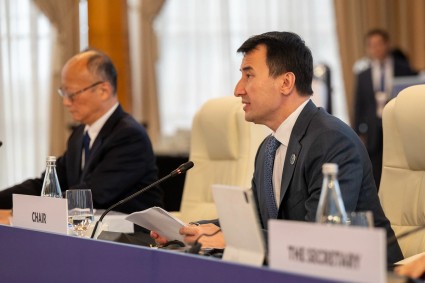
Uzbekistan views regional cooperation as a vital tool for mitigating the risks associated with large-scale infrastructure and energy projects. This statement was made by Deputy Prime Minister Jamshid Khodjaev during a panel session at the Asian Development Bank (ADB) annual meeting in Samarkand on May 5.
“Our nation is situated at the very heart of the region, bordering every other Central Asian country. This geographical reality means that Uzbekistan must naturally serve as a coordinator or catalyst for regional initiatives,” Khodjaev remarked.
He noted that under the president Shavkat Mirziyoyev, the approach to project risk management has evolved. Specifically, he argued that regional collaboration itself acts as a de-risking mechanism.
“I’d like to offer a slightly different perspective on risk mitigation, where the ADB also plays a role. Consider a massive hydropower initiative, such as the major project in Kyrgyzstan with a capacity exceeding 1 GW. We refer to it as the Kambarata-1 Hydropower Plant. While current estimates for certain stages sit around $1 billion, its scope is far larger,” he stated.
Kambarata-1 is Kyrgyzstan's most ambitious energy project, located on the Naryn River in the Jalal-Abad region. Once completed, the plant is expected to have a capacity of 1,860 MW, featuring a 256-meter-high dam and a reservoir holding 5.4 billion cubic meters of water. The station is projected to generate an average of 5.6 billion kWh of electricity annually. Construction is estimated to take a decade, with Uzbekistan’s Energy Minister, Jurabek Mirzamahmudov, previously estimating the total project cost at approximately $4.2 billion.
Khodjaev emphasized that a project of this magnitude is nearly impossible for a single nation to execute due to the sheer scale and associated risks.
"This project effectively cannot be built by one country alone because the risks would place an overwhelming burden on a single government. Attempting to go solo on something this massive would simply create too much strain," the Deputy Prime Minister explained.
He further explained that this collaborative model is being applied not only to individual power plants but also to broader infrastructure modernization.
"We are talking about regional projects that benefit the entire area, not just one nation. This is one of the compelling approaches we are implementing. The same logic applies to modernizing our infrastructure; it is fundamentally a regional endeavor because we are talking about upgrading the entire power grid," he stated.
The Deputy Prime Minister noted that regional neighbors are working toward a more interconnected electrical system.
"As I mentioned earlier, our goal is to create a unified common power grid. We are currently working with our neighbors on digitalization, which is the only way to effectively balance energy loads. We are interdependent—we buy, sell, and trade electricity with one another," Khodjaev said.
In response to whether this creates a larger, more attractive market for investors, he confirmed: "That is exactly the point."
As a final example of risk mitigation, Khodjaev pointed to the ambitious plan to export "green" energy from Central Asia to Europe via Georgia and Azerbaijan.
"In the end of the day, to successfully sell green energy produced in our region to the European market, we must reduce risks across the entire supply chain," he concluded.
Stay up to date with all the latest news: