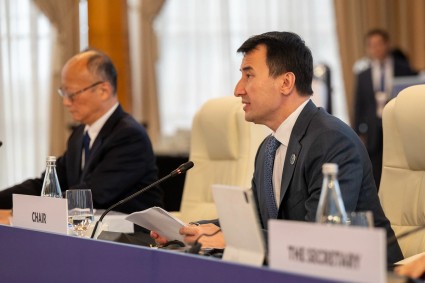
In recent years, Uzbekistan has transformed from a net power importer into an exporter that supplies its neighbors and plays a key role in developing regional and transcontinental power corridors, the Deputy PM Jamshid Khodjaev made these remarks on May 5 during a panel session at the Asian Development Bank’s meeting in Samarkand.
“Imagine a country that, just a decade ago, was strictly an power importer, and now is becoming something entirely different,” Khodjaev stated.
Khodjaev emphasized that these reforms have enabled private companies to begin investing in both power generation and power storage systems within the country.
“In recent years, we have attracted nearly $35 billion in investment specifically for the power sector. We have already commissioned 9 GW of new generating capacity,” he announced.
According to the Deputy PM, electricity production has climbed nearly 40%, rising from 60 billion to 85 billion kWh annually. The country has already integrated nearly 6 GW of solar and wind power, with green generation growing by an average of 4 GW every year.
Khodjaev concluded by highlighting Uzbekistan’s role as a “reliable regional supplier.” In 2025 alone, the country exported roughly 500 million kWh to Kazakhstan, 400 million kWh to Tajikistan, 1.2 billion kWh to Kyrgyzstan, and over 2 billion kWh to Afghanistan.
He noted that Uzbekistan’s economy has surged from $60 billion to $145 billion. This growth, he explained, is the fruit of sweeping reforms across nearly all sectors—efforts that continue to push the nation toward international standards, a market economy, and a “favorable, bankable investment climate.”
“Previously, the country was a power importer. Now, we strive to assist our neighbors during shortages by selling them our electricity. Without transforming the power market and fostering an investor-friendly environment, we wouldn't have even been able to power our own industries. Today, the nation has become an exporter,” he said.
The Deputy PM noted that Uzbekistan’s role in regional power is strengthening through infrastructure expansion. The country is currently constructing 220 kV and 500 kV power lines and substations in Afghanistan and neighboring states, with completion slated for 2027.
Beyond bilateral trade, Uzbekistan is a key player in integrating Central Asian power grids. Khodjaev highlighted the "Regional Electricity Market Innovation and Transformation" (REMIT) program, which regional nations are implementing with World Bank support.
He also announced that Uzbekistan is co-developing a High-Voltage Direct Current (HVDC) project to export "green" electricity to Europe via Kazakhstan, the Caspian Sea, Azerbaijan, and Georgia. The Asian Development Bank is providing assistance for the project’s feasibility study.
“In tandem, discussions are underway regarding a potential connection to China’s power grid, which would further broaden our integration’s geographical reach,” Jamshid Khodjaev added.
The Deputy PM stated that Uzbekistan is steadily evolving beyond its traditional power role.
“The country is moving past its conventional boundaries and is now positioning itself as a reliable power producer, an efficient transit corridor, and most importantly, a regional integrator of power systems,” he remarked.
According to Khodjaev, the nation has "very ambitious plans": modernizing the power grid, adding new generating capacity annually, digitalizing the electrical system, and developing new power sources, including nuclear power plants.
Follow us on: